Most people think a military strike starts with a button press.
It doesn’t.
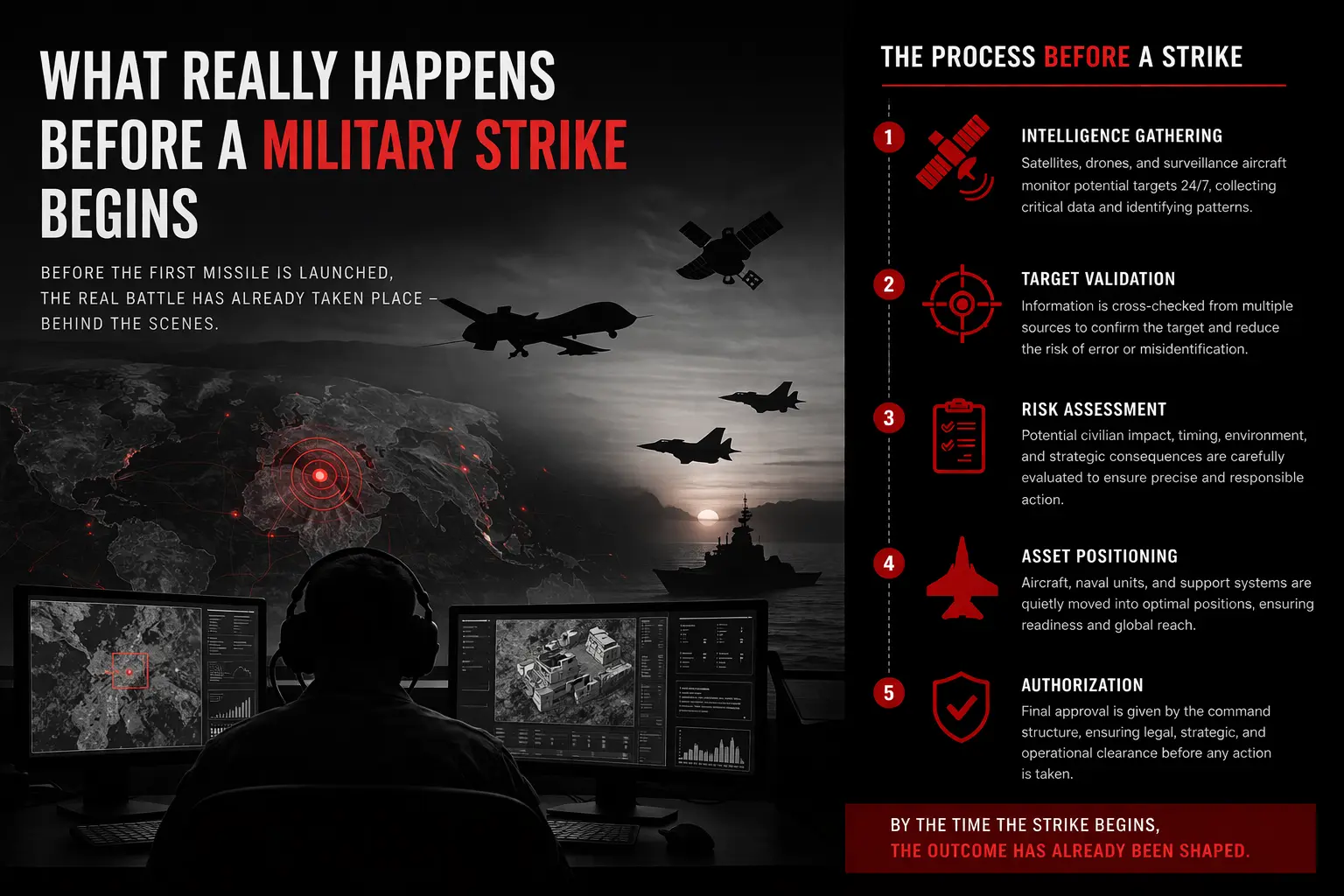
By the time that moment comes, dozens of systems have already done their job—collecting data, verifying targets, and reducing uncertainty.
The real process is slower. More calculated.
And far less visible.
Main Explanation
A modern military strike, especially in the US system, follows a structured chain. It’s not rushed. It’s built step by step.
Here’s a simplified breakdown:
Stage | What Happens | Why It Matters |
|---|---|---|
Intelligence Gathering | Satellites, drones, surveillance planes | Identifies potential targets |
Target Validation | Cross-checking data from multiple sources | Reduces error |
Risk Assessment | Civilian presence, timing, fallout | Prevents unintended damage |
Asset Positioning | Aircraft, ships, and systems move closer | Ensures readiness |
Authorization | Final approval from command | Legal and strategic clearance |
It usually starts with observation.
Military satellites and drones monitor areas continuously. Patterns are studied—movement, communication, behavior. Not once, but repeatedly.
Then comes validation.
One source is never enough. Data is confirmed through multiple channels. If something doesn’t match, the process slows down.
Because mistakes here are costly.
After that, risk is evaluated. Timing becomes critical. A target might be valid, but not at the wrong moment.
And quietly, assets begin to move.
Aircraft shift positions. Naval units adjust routes. Everything aligns without drawing attention.
Only then does the final authorization come in.
Impact
This layered process changes how modern warfare works.
It’s no longer reactive. It’s predictive.
By the time a strike is executed, uncertainty is minimized. The system is designed to avoid surprises.
And that creates control.
“The strike is not the decision. It’s the result of decisions already made.”
“Speed matters, but accuracy decides outcomes.”
“The quieter the preparation, the stronger the execution.”
Real-Life Observation
You’ve probably seen breaking news alerts—“strike carried out,” “target hit.”
It feels sudden.
But in reality, that moment is just the visible tip of a much longer process.
Most of it happened without headlines.
Trend: Then vs Now
The way military strikes are prepared has changed significantly.
Earlier Approach | Modern Approach |
|---|---|
Faster, less data-driven | Data-heavy and verified |
Limited surveillance | Continuous real-time monitoring |
Higher uncertainty | Reduced risk through validation |
Immediate reaction | Calculated preparation |
Earlier conflicts often relied on faster decisions with limited information.
Now, information comes first.
That shift has made operations more precise—but also more dependent on technology.
Insight
Here’s the key difference most people miss.
A military strike today is not just an action. It’s a process.
Each layer—intelligence, validation, positioning—builds toward a point where the final step becomes almost predictable.
In some cases, the strike itself becomes the least complex part.
Conclusion
So what really happens before a military strike begins?
Everything.
Observation, verification, positioning, and decision-making—all happen before anything visible takes place.
By the time the strike is launched, the situation is already shaped.
And that’s the reality of modern military strategy.
The outcome is often decided before the first move is seen.