From the outside, a fighter jet mission looks fast and controlled.
Inside the cockpit, it’s intense.
Pilots aren’t just flying. They’re processing information, tracking targets, communicating with command, and making decisions in real time.
There’s no pause.
Main Explanation
A fighter jet mission follows a structured flow, but what the pilot experiences is far from simple.
Here’s how it typically unfolds:
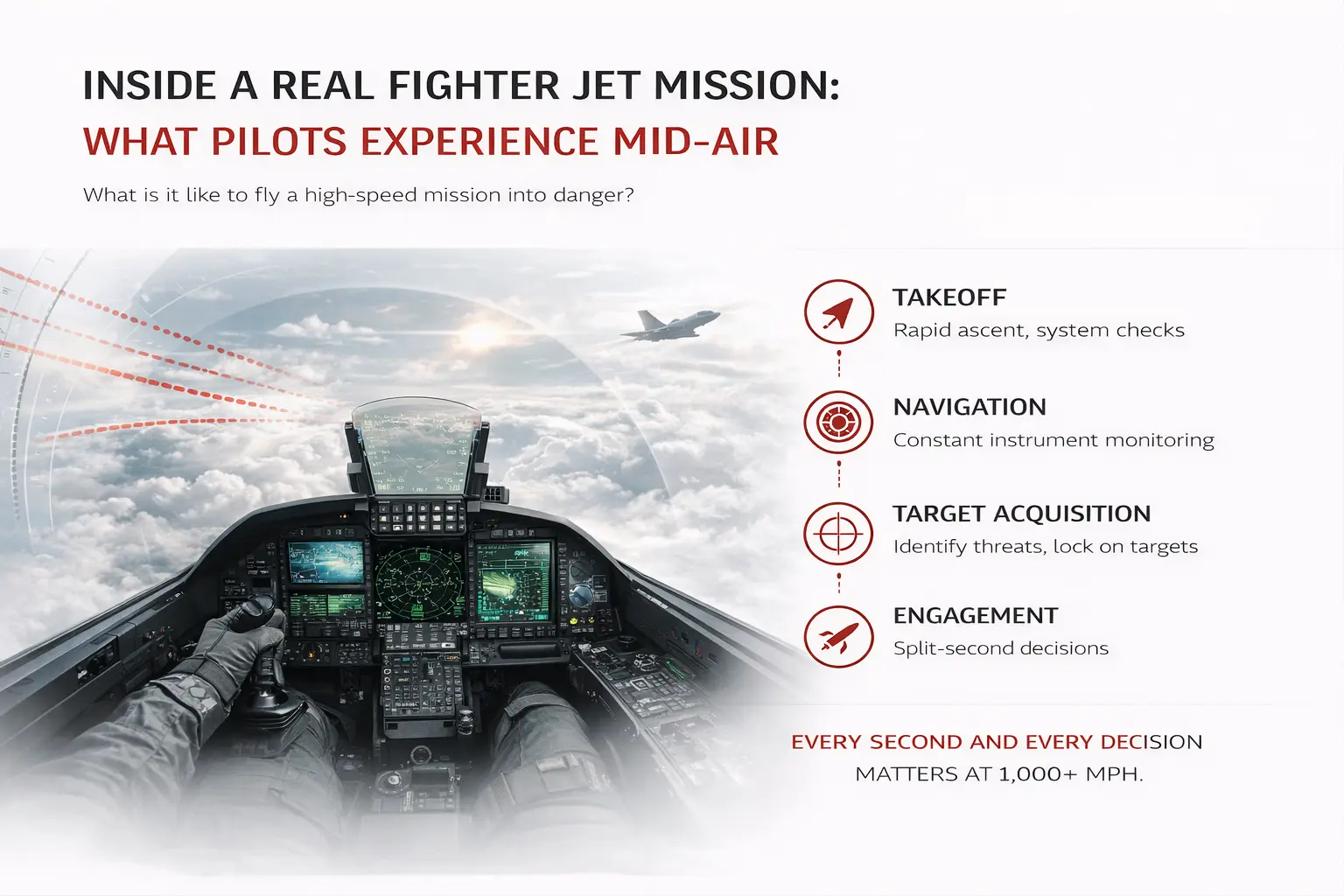
Phase | What Happens | Pilot Experience |
|---|---|---|
Takeoff | Rapid ascent and system checks | High focus, quick adjustments |
Navigation | Moving toward target area | Monitoring instruments constantly |
Target Acquisition | Identifying and locking targets | High mental load |
Engagement | Action phase (if required) | Split-second decisions |
Exit Strategy | Leaving the area safely | Controlled but alert |
Inside the cockpit, everything is compact.
Multiple screens display radar, maps, targets, and system data. Pilots constantly shift attention between them.
At high speed.
Communication is continuous.
Pilots receive instructions, share updates, and coordinate with other aircraft. Even small delays can affect timing.
And then there’s situational awareness.
Knowing where you are, where others are, and what’s changing around you—all at once.
Impact
This level of intensity shapes how missions are executed.
Pilots don’t just follow instructions.
They adapt.
Conditions change quickly—weather, movement, signals. Decisions have to be made in seconds, often with incomplete information.
“Speed is not just physical. It’s mental.”
“A pilot manages systems, not just the aircraft.”
“Awareness is the difference between control and risk.”
Real-Life Observation
Think about driving in heavy traffic.
Now imagine doing that at extreme speed, while managing multiple screens, communicating constantly, and reacting instantly.
That’s a small glimpse.
Now multiply it.
Trend: Then vs Now
The role of the pilot has evolved.
Earlier Role | Modern Role |
|---|---|
Manual flying focus | System management + decision-making |
Limited data | High data environment |
Basic communication | Constant network coordination |
Reactive actions | Predictive responses |
Earlier, pilots focused more on flying itself.
Now, they manage information as much as the aircraft.
Insight
Here’s what most people don’t realize.
Flying the jet is only part of the job.
Managing information is the real challenge.
Pilots act as decision nodes—processing inputs, evaluating risks, and acting quickly.
That’s what defines a mission.
Conclusion
So what happens inside a real fighter jet mission?
It’s fast. It’s intense. And it’s highly controlled.
Pilots operate in a space where speed, information, and timing come together.
And success depends not just on the aircraft—but on how well everything is managed inside it.