Main Explanation — What Actually Happened
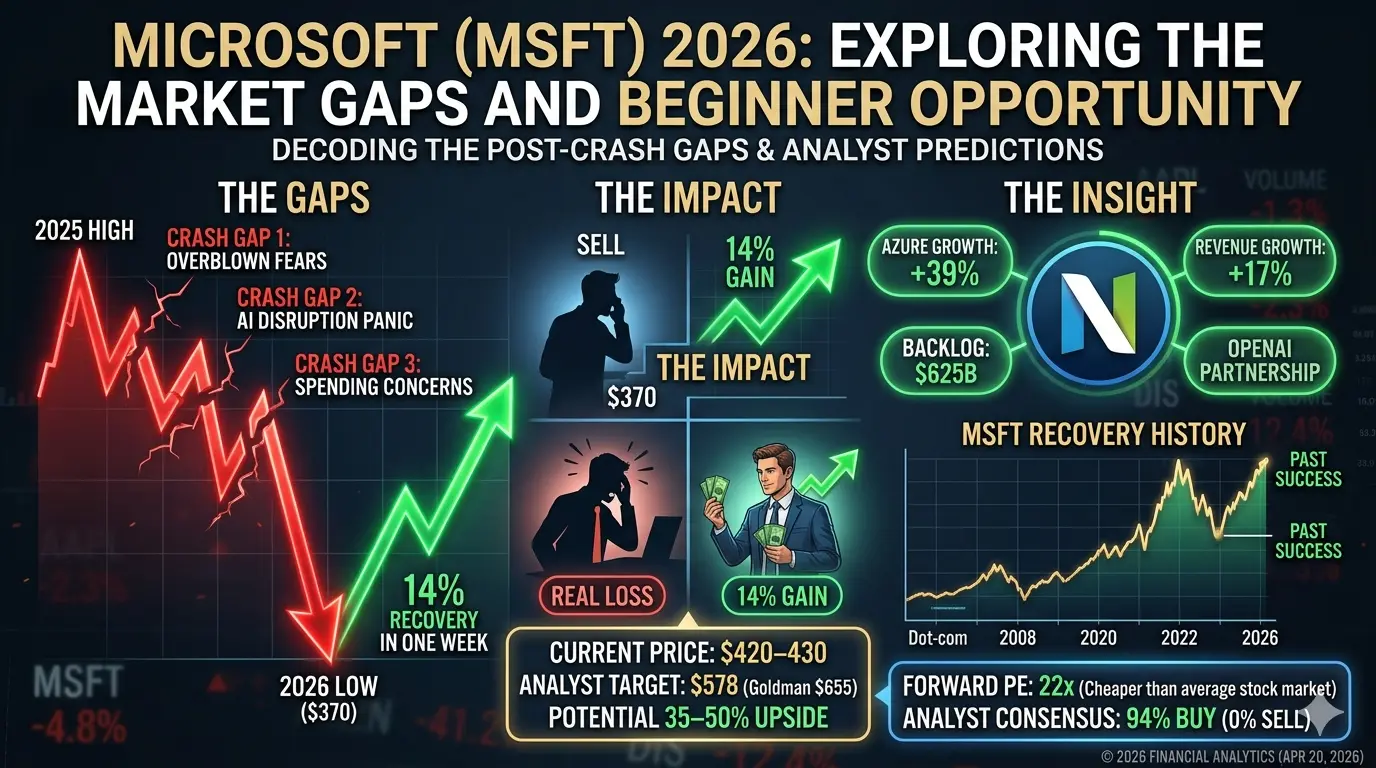
Microsoft has had a brutal first quarter of 2026. The stock dropped nearly 31% from its all-time high set in late 2025. That is not a small correction. That is the kind of move that wipes out billions in value and scares ordinary investors completely out of the stock.
But here is what makes this story interesting.
The business itself never broke. Not even close.
In its last earnings report, Microsoft grew revenue 17% year on year. Azure — its cloud computing platform — grew 39%. The company has $625 billion in locked-in future contracts from customers. It holds a 27% stake in OpenAI, the company behind ChatGPT. And its next earnings report drops on April 29, 2026 — just days away.
So why did the stock crash so hard?
Two fears drove the selloff. First, Microsoft spent $37.5 billion in a single quarter building AI infrastructure — data centres, chips, servers. Investors panicked about whether that spending would ever pay off. Second, the broader market sold off technology stocks in early 2026 on concerns about AI disrupting traditional software businesses. Microsoft, ironically, sits at the centre of both fears — it is both an AI builder and a traditional software company.
The result? A world-class company got sold like it was struggling. And then last week, investors woke up.
Sometimes the market sells great companies for the wrong reasons. That gap between price and reality is where opportunity lives.
Impact — What This Means For Everyday Investors
Here is the part most finance articles skip entirely.
For someone in the US, UK, or Canada who puts money away every month into stocks, Microsoft's correction was either a nightmare or a gift — depending entirely on how they reacted.
The people who panicked and sold near $370 locked in real losses. The people who stayed calm or bought more are now sitting on a 14% gain in a single week. That is five months of average stock market returns compressed into five days.
Think about that for a second.
Now Microsoft is trading around $420–430. Analysts have an average price target of around $578. Goldman Sachs has a target of $655. That means even after last week's 14% jump, the stock could still have 35–50% upside over the next 12 months — if analysts are right.
This is not a small, risky startup. This is a $3 trillion company that runs the software on most of the world's computers, hosts AI models for thousands of businesses, and generates billions in profit every single quarter.
Most people wait for certainty before investing. But certainty always comes after the price has already moved.
Insight — The Uncomfortable Truth About Microsoft in 2026
Here is something the headlines are not saying clearly enough.
Microsoft has now recovered from four major crashes — the dot-com bust, the 2008 financial crisis, the 2020 pandemic crash, and the 2022 inflation shock. Every single time, investors who bought during the fear ended up ahead. Every single time.
The 2026 correction followed the exact same pattern. Deep fear. Panic selling. Then a sharp recovery.
What changed this time? Nothing about the business. Azure is still growing at 39%. The OpenAI partnership is still intact. Earnings are still growing around 21% annually. The $625 billion backlog means Microsoft already has years of future revenue locked in before it has sold a single new contract.
In fact, at 22 times forward earnings, Microsoft right now is cheaper than the average S&P 500 stock. That almost never happens. The last time Microsoft was this cheap relative to the market was 2017.
Let that sink in.
A company spending tens of billions building the AI future, partnered with OpenAI, running Azure for half the world's businesses — trading cheaper than the average stock market company.
That is either a massive warning sign or a massive opportunity. Given everything we know about Microsoft's fundamentals, most serious analysts are firmly in the opportunity camp. 94% of the 31 analysts covering the stock currently rate it a Buy or Strong Buy. Zero rate it a Sell.
The last time a world-class tech company was this unloved by its stock price, patient investors made generational returns. History does not repeat exactly — but it rhymes.
Conclusion
Microsoft did not become a bad company in 2026. It became a misunderstood one.
The business is growing. The AI strategy is working. The earnings are strong. The stock just got caught in a wave of fear that had more to do with market emotion than business reality.
Now it has started recovering. And the question is no longer whether you missed the bottom — the question is whether you have the patience to hold through whatever volatility comes next, including the April 29 earnings report, and let the fundamentals do their work over 2–3 years.
The investors who bought Microsoft during the dot-com crash, during 2008, during COVID — they are not complaining today.
Buying a great company when everyone else is afraid is not a guarantee. But it has been one of the most reliable wealth-building strategies in stock market history. April 2026 may be one of those moments.
SEO Meta Description:
Microsoft stock dropped 23% in 2026 then jumped 14% in one week. We explain why it crashed, what analysts predict, and whether beginners should buy MSFT right now.