Introduction
Fuel prices are no longer just numbers on a board. They are becoming a daily stress.
From office workers to delivery riders, everyone feels the pressure. Petrol prices are high, and they keep rising. For someone driving 50–70 km every day, fuel is now one of the biggest monthly expenses.
At the same time, something interesting is happening.
More people are quietly moving towards CNG cars in India. Not because it’s trendy—but because it’s practical.
Main Explanation: What’s Changing and Why
Let’s keep it simple.
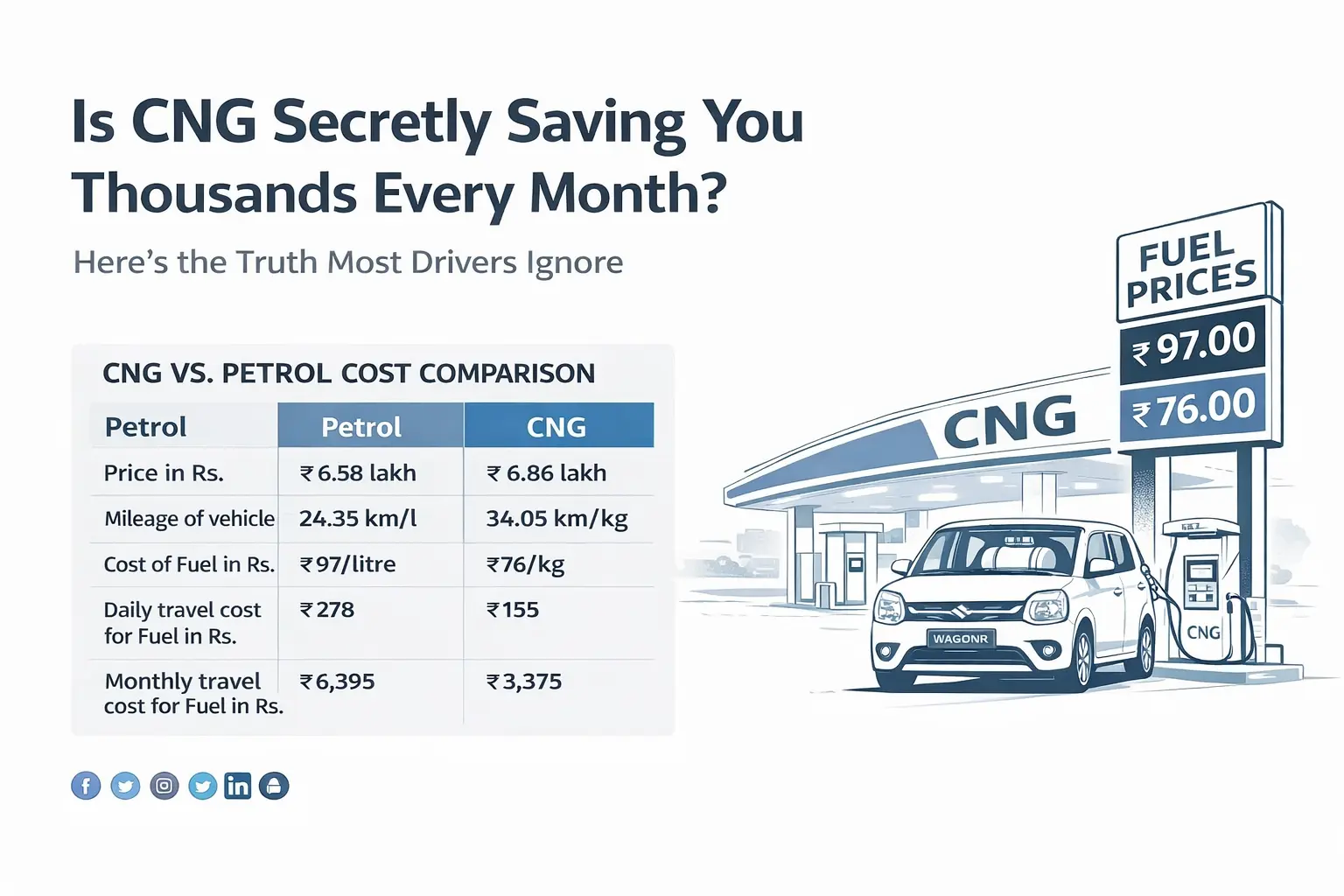
A petrol car today gives around 24 km per litre. A CNG car of the same model can give around 34 km per kg. Now look at fuel prices—petrol around ₹97/litre, CNG around ₹76/kg.
Now calculate real usage.
If you travel about 70 km daily:
Petrol cost per day: ~₹278
CNG cost per day: ~₹155
Monthly (around 1,600 km):
Petrol: ~₹6,300
CNG: ~₹3,500
That’s a saving of nearly ₹3,000 every month.
Over a year, that becomes more than ₹35,000.
This is why searches like “CNG savings India” and “petrol vs CNG cost comparison” are growing fast.
Because the math is simple—and powerful.
Impact: Real Life, Real People
For many people, this is not just about saving money. It’s about managing life better.
Think about a Swiggy or Zomato delivery rider. He drives all day. Fuel is his biggest cost. Switching to CNG means more money stays in his pocket.
Even office commuters are noticing the difference.
One small change. One big impact.
Because when your monthly fuel bill drops, your financial stress also drops.
But yes, there are compromises.
Less boot space because of the CNG cylinder
Longer waiting time at CNG stations
Slightly lower performance in some cars
Still, most users accept it.
Because saving every day matters more than comfort once in a while.
Insight: The Bigger Truth
“People don’t change habits easily. They change when the cost becomes painful.”
That’s exactly what’s happening.
CNG is not winning because it’s perfect. It’s winning because petrol is getting expensive.
And here’s something deeper.
Earlier, people used to say, “Petrol cars feel premium.”
Now people say, “CNG cars feel smart.”
That shift matters.
“Smart decisions are replacing expensive habits.”
And slowly, this is becoming the new middle-class mindset in India.
Conclusion
CNG is no longer just an option. It’s becoming a strategy.
A way to survive rising fuel costs.
A way to reduce daily expenses.
A way to think smarter about money.
Petrol still has its place. But its dominance is clearly reducing.
And the biggest reason is simple—
People are not chasing luxury anymore.
They are chasing control over their expenses.