A fighter jet looks fast, aggressive, unstoppable.
But there’s a limitation.
Fuel.
Without support, even the most advanced US military jet can only stay airborne for a few hours. That’s not enough for long-range missions.
So how do they operate across continents?
They refuel.
In the sky.
Main Explanation
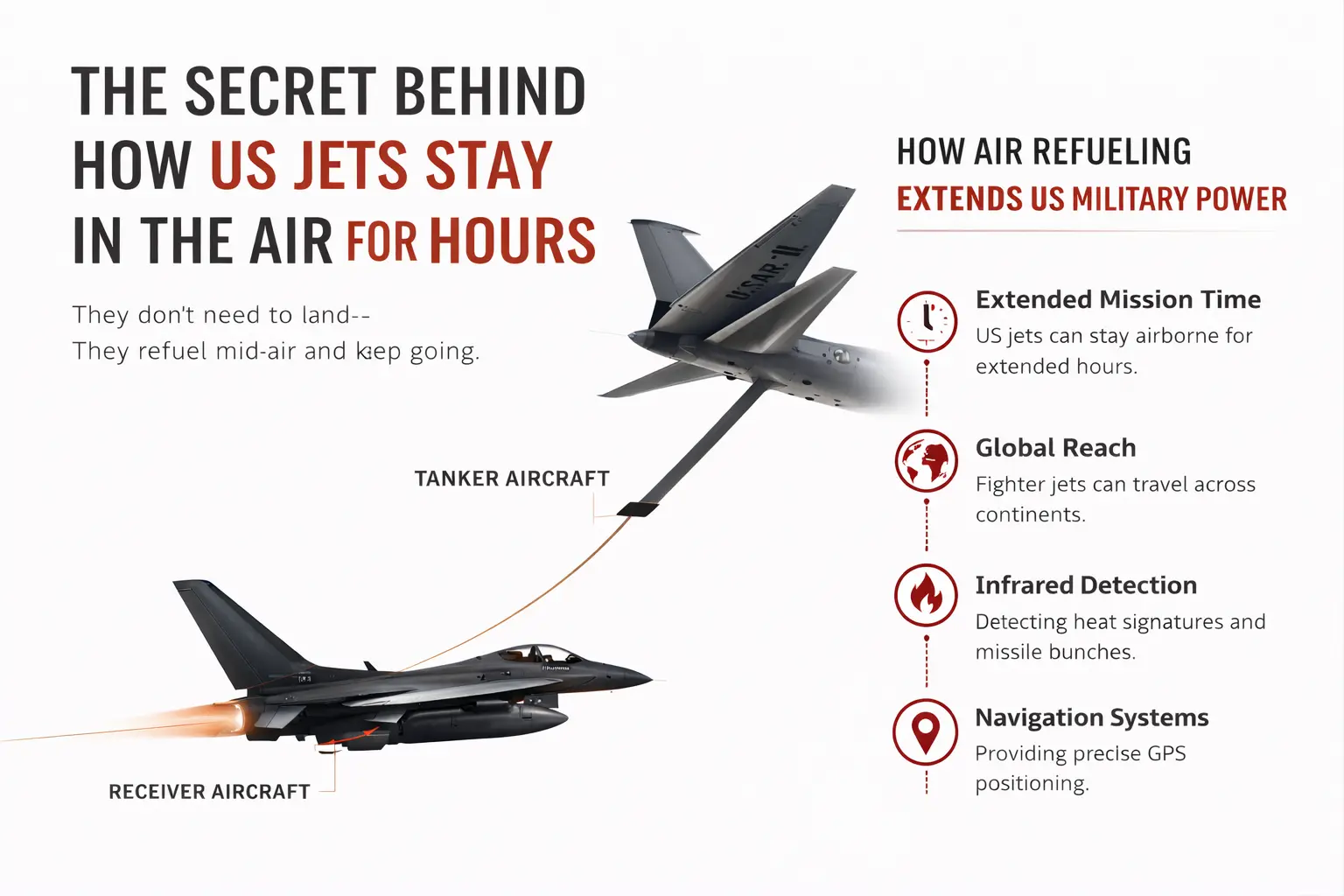
Air refueling—also called mid-air refueling—is one of the most critical systems in modern US military aviation.
It allows aircraft to receive fuel while still flying.
No landing. No pause.
Here’s how it works:
Component | Role | Why It Matters |
|---|---|---|
Tanker Aircraft | Carries large fuel supply | Acts as flying fuel station |
Receiver Aircraft | Fighter jet or bomber | Extends mission time |
Boom or Probe System | Transfers fuel mid-air | Enables connection at high speed |
Coordinated Flight | Both aircraft fly in sync | Precision and safety |
A tanker aircraft—like those used by the US Air Force—flies ahead or meets jets mid-route.
The receiving jet aligns carefully behind it.
Then comes the delicate part.
A boom (a rigid fuel pipe) or probe connects between the two aircraft. Fuel starts flowing while both planes are moving at high speed.
It’s not easy.
It requires precision, steady control, and constant communication.
One mistake, and the connection breaks.
Impact
This system completely changes what military aircraft can do.
Without refueling, range is limited. Missions are shorter. Options are fewer.
With refueling?
Aircraft can:
Stay airborne for extended hours
Travel across continents without landing
Maintain constant presence over strategic areas
It’s not just about endurance.
It’s about reach.
“Range used to limit power. Refueling removed that limit.”
“The mission doesn’t end when fuel runs low anymore.”
“Air refueling turns aircraft into continuous systems, not short bursts.”
Real-Life Observation
You’ve probably seen long-haul commercial flights.
Even they need strict fuel planning and landing schedules.
Now imagine military jets flying faster, carrying weapons, and still staying airborne longer.
That’s only possible because refueling happens mid-air.
Quietly.
Trend: Then vs Now
Air refueling has evolved significantly over time.
Earlier Capability | Modern Capability |
|---|---|
Limited refueling tech | Highly precise systems |
Fewer tanker aircraft | Global refueling network |
Short mission duration | Long-endurance operations |
Regional reach | Global reach |
Earlier, aircraft had to rely heavily on nearby bases.
Now, they can operate far beyond those limits.
Distance is no longer the main constraint.
Insight
Here’s what most people don’t realize.
Air refueling doesn’t just support missions.
It defines them.
Military planners can design operations assuming aircraft will stay in the air longer than expected. That changes strategy entirely.
Suddenly, timing becomes flexible. Routes become unpredictable.
And presence becomes continuous.
Conclusion
So what’s the secret behind how US jets stay in the air for hours?
They don’t rely on what they carry.
They rely on what meets them mid-air.
Air refueling removes one of the biggest limitations in aviation—fuel capacity—and replaces it with coordination.
And that small shift creates a massive advantage.
Because in modern warfare, staying in the air longer often means staying in control longer.