Introduction
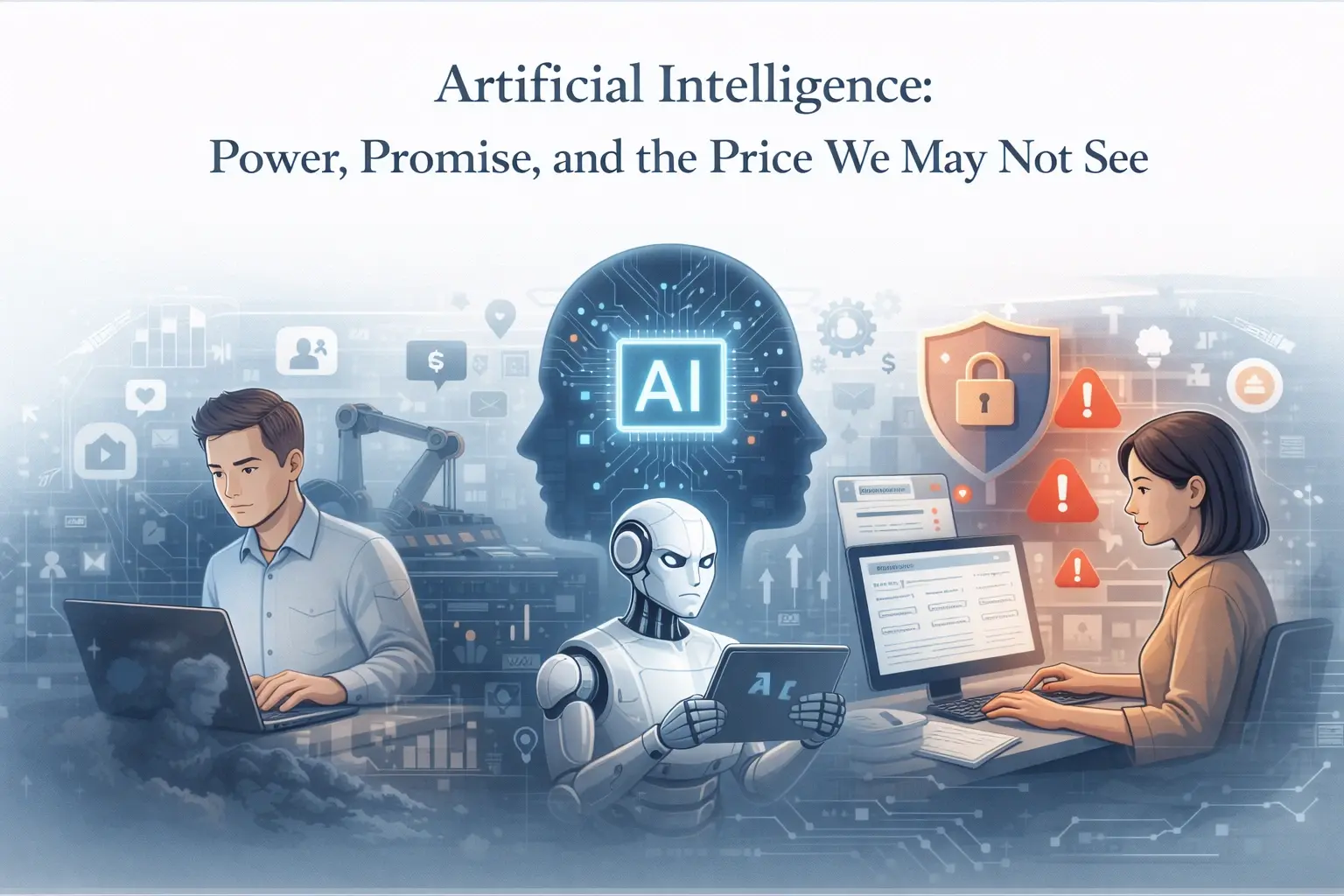
Artificial Intelligence has become one of the most transformative technologies of the modern era. From healthcare and education to finance and entertainment, AI is reshaping industries and redefining how humans interact with machines. However, like any powerful tool, AI comes with both advantages and challenges. A SWOT analysis, which examines strengths, weaknesses, opportunities, and threats, helps us better understand the overall impact of AI and how it can be managed responsibly.
Strengths of Artificial Intelligence
One of the biggest strengths of AI is its ability to process large amounts of data quickly and accurately. Unlike humans, AI systems can analyze complex datasets in seconds, making them extremely useful in fields like medical diagnosis, financial forecasting, and scientific research. This leads to better decision-making and improved efficiency.
Another key strength is automation. AI can perform repetitive and time-consuming tasks without fatigue. This not only increases productivity but also allows humans to focus on more creative and strategic work. Industries such as manufacturing and customer service have greatly benefited from automation through AI-powered systems.
AI also improves accuracy and reduces human error. For example, in healthcare, AI tools can assist doctors in detecting diseases at early stages with high precision. In transportation, AI-driven systems help improve road safety through advanced driver assistance technologies.
Additionally, AI offers personalization. Platforms like streaming services and e-commerce websites use AI algorithms to recommend content and products based on user preferences, enhancing user experience and satisfaction.
Weaknesses of Artificial Intelligence
Despite its strengths, AI has several limitations. One major weakness is its dependence on data. AI systems require large amounts of high-quality data to function effectively. If the data is incomplete, biased, or inaccurate, the results produced by AI can also be flawed.
Another concern is the lack of human judgment and emotional intelligence. AI cannot fully understand human emotions, ethics, or social contexts. This makes it less effective in situations that require empathy, moral reasoning, or complex human interaction.
The high cost of development and implementation is another drawback. Building and maintaining AI systems requires significant investment in technology, infrastructure, and skilled professionals. This can make AI less accessible for smaller organizations.
Furthermore, AI systems can sometimes lack transparency. Many advanced AI models operate as "black boxes," meaning it is difficult to understand how they arrive at certain decisions. This lack of explain ability can create trust issues, especially in critical areas like healthcare and law.
Opportunities of Artificial Intelligence
AI presents numerous opportunities for growth and innovation. One of the most promising areas is healthcare. AI can revolutionize diagnosis, treatment planning, and drug discovery, leading to better patient outcomes and reduced healthcare costs.
In education, AI can enable personalized learning experiences. Students can learn at their own pace, and teachers can receive insights into student performance, helping them provide better support.
AI also has the potential to boost economic growth. By increasing productivity and creating new industries, AI can generate employment opportunities in areas such as data science, machine learning, and robotics.
Another important opportunity lies in solving global challenges. AI can be used to address issues like climate change, energy management, and disaster prediction. For example, AI models can analyze environmental data to predict natural disasters and help in planning preventive measures.
Smart cities are another area where AI can play a crucial role. From traffic management to waste disposal, AI can improve urban living conditions and make cities more efficient and sustainable.
Threats of Artificial Intelligence
While AI offers many benefits, it also poses serious threats. One of the most significant concerns is job displacement. As automation increases, many traditional jobs may become obsolete, leading to unemployment and economic inequality.
Another major threat is the misuse of AI. Technologies like deepfakes, surveillance systems, and autonomous weapons can be used for harmful purposes. This raises ethical and security concerns that need to be addressed through proper regulations.
Data privacy is also a critical issue. AI systems often rely on personal data, which can be misused or leaked if not properly protected. This can lead to loss of privacy and trust among users.
Bias in AI systems is another growing concern. If AI models are trained on biased data, they can produce discriminatory outcomes, affecting fairness and equality in areas like hiring, lending, and law enforcement.
Finally, there is the risk of over-dependence on AI. As society becomes more reliant on AI systems, any failure or malfunction can have widespread consequences. This highlights the need for human oversight and robust safety measures.
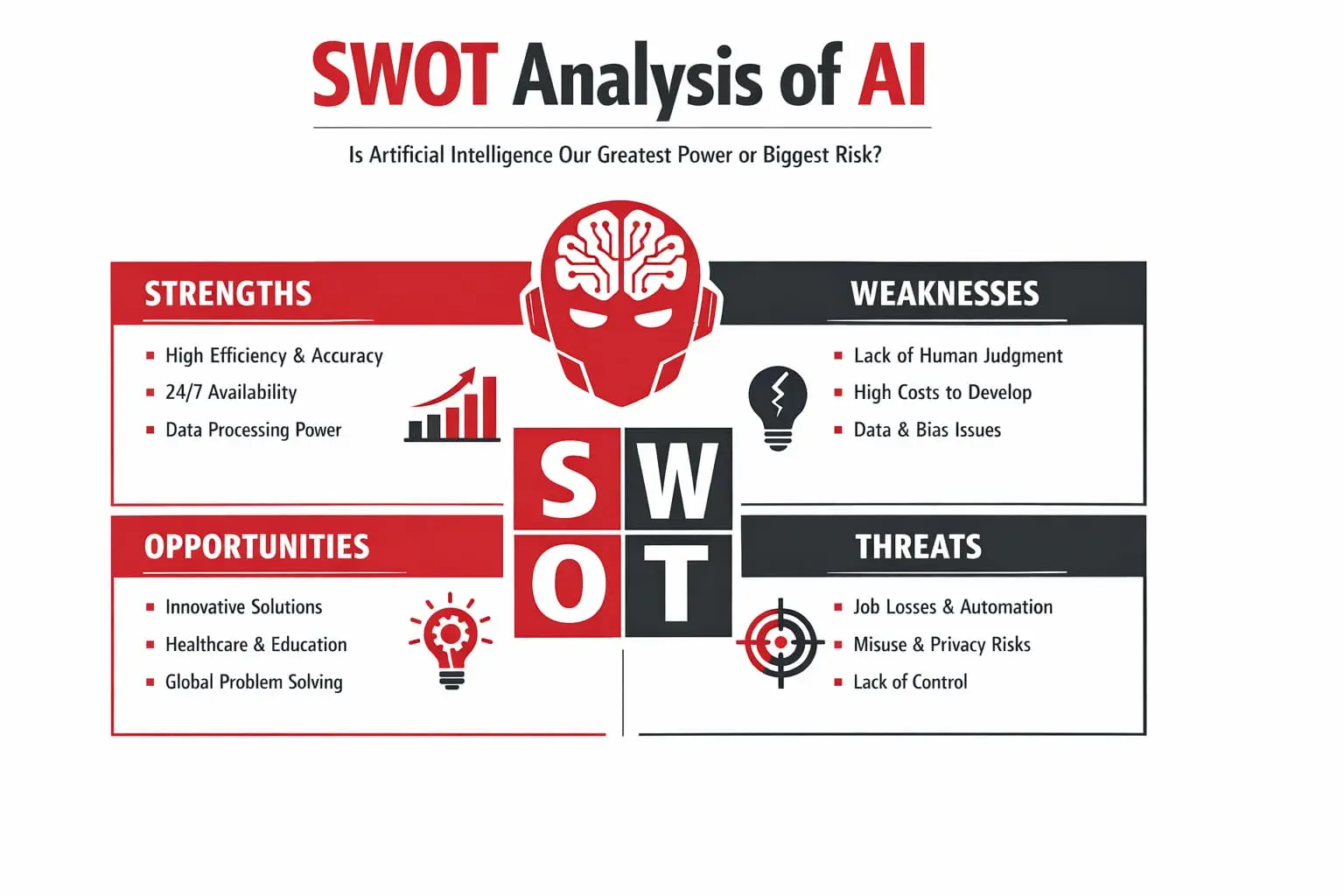
SWOT Analysis of Artificial Intelligence
Aspect | Description |
|---|---|
Strengths | Processes large amounts of data quickly and accurately, improves decision making, enables automation, reduces human error, and offers personalized experiences. |
Weaknesses | Depends on high quality data, lacks emotional intelligence and human judgment, involves high development costs, and lacks transparency in decision making. |
Opportunities | Improves healthcare and education, supports economic growth, creates new job roles, and helps solve global challenges like climate change. |
Threats | Job displacement, misuse of AI technologies, data privacy risks, biased outcomes, and over dependence on automated systems. |
Conclusion
Artificial Intelligence is a powerful technology with the potential to transform the world in unprecedented ways. Its strengths in data processing, automation, and accuracy make it a valuable tool across various sectors. However, its weaknesses, such as data dependency and lack of emotional intelligence, cannot be ignored.
The opportunities presented by AI are vast, ranging from improved healthcare and education to economic growth and environmental sustainability. At the same time, the threats, including job loss, ethical concerns, and data privacy issues, require careful consideration.
A balanced approach is essential for the future of AI. Governments, organizations, and individuals must work together to maximize its benefits while minimizing its risks. By implementing strong regulations, promoting ethical practices, and ensuring transparency, we can harness the full potential of AI for the betterment of society.