Tesla is supposed to be a car company. So why is its stock moving on news about a robot?
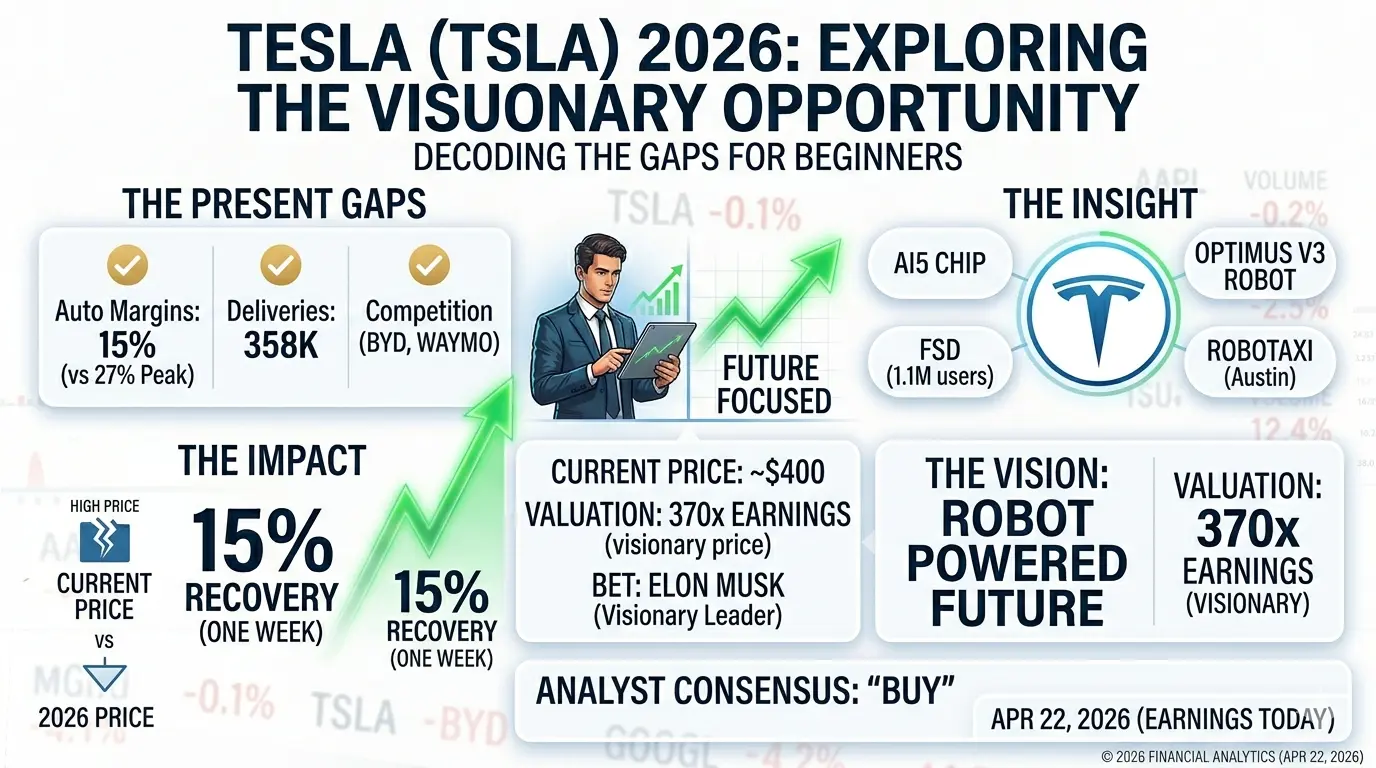
That single question explains everything happening with Tesla in April 2026. The stock crashed more than 40% from its highs. Sales disappointed. Margins shrunk. Then Elon Musk announced progress on an AI chip called AI5 — and the stock jumped 15% in one week.
This is not a normal company anymore. And understanding that is the key to understanding whether Tesla is a buy, a sell, or something you should just watch from a safe distance.
Main Explanation — What Is Actually Happening at Tesla
Let us start with the facts on the ground.
In Q1 2026, Tesla delivered 358,023 vehicles. That missed analyst expectations of around 365,000. The company also produced 408,000 cars — meaning roughly 50,000 vehicles are sitting unsold in inventory right now. Automotive gross margins have fallen to around 15%, down sharply from the 27% peak Tesla once proudly reported.
On paper, this looks like a struggling car company.
But here is the twist — Tesla is quietly trying to stop being a car company.
In recent weeks, Elon Musk announced meaningful progress on three things that have nothing to do with selling Model 3s. First, the AI5 chip — a next-generation processor designed for Tesla vehicles and future robotaxis that makes the car's brain dramatically smarter. Second, the Optimus humanoid robot, now in Version 3, which Tesla claims will eventually be worth more than the entire car business. Third, robotaxi operations are actively expanding in Austin, Texas — real rides, real customers, real revenue.
These are the things making investors excited. Not the cars.
Tesla is going through an identity crisis in real time — and the market is betting heavily that the new identity wins.
Tesla is no longer just selling you a car. It is trying to sell the world a robot-powered future. The question is whether that future arrives before the money runs out.
Impact — What This Means For Real Investors
If you bought Tesla at its peak near $550 in late 2025, you are still sitting on painful losses even after last week's rally. The stock remains down over 15% year to date in 2026, and down more than 25% from its all-time high.
That is the honest reality that most bullish headlines gloss over.
But here is where it gets interesting for someone looking at this fresh.
Tesla earnings drop on April 22, 2026 — today. Wall Street analysts expect revenue of around $21.4 billion, up 13% year on year. Earnings per share are expected around $0.33 on an adjusted basis — a 33% jump from the same period last year. FSD subscriptions, Tesla's self-driving software service, grew 38% year on year to 1.1 million users. That is a recurring software revenue stream that most people completely ignore when thinking about Tesla.
And then there is the bigger picture. For the full year 2026, analysts expect earnings to grow 31% compared to 2025. By 2027 that growth accelerates further. If those numbers hit, the stock at current prices starts to look reasonable — even cheap.
But prediction markets currently give only a 37% chance of Tesla beating earnings expectations. The stock has enormous hype built into it. At around $400 per share, Tesla trades at roughly 370 times earnings — meaning investors are paying for decades of future profits today.
That is either visionary thinking or expensive hope. Depending on who you ask, you will get completely opposite answers.
Insight — The Uncomfortable Truth About Tesla in 2026
Here is the thing nobody wants to say plainly.
Tesla is competing against itself right now.
Its core EV business is under real pressure. Chinese competitor BYD is outselling Tesla in multiple global markets. Price cuts meant to defend market share are destroying profit margins. Musk's involvement in US politics has triggered boycotts and brand damage in key European and American markets. One in five Cybertrucks registered in the US last quarter was sold to Musk's own other companies — not real customers. These are not comfortable facts.
At the same time, Waymo — Google's robotaxi service — is already completing over 250,000 paid trips every week across major US cities. Tesla's robotaxi is still in early testing. The robot Optimus is still in development. The AI5 chip is not yet in production vehicles.
So Tesla is asking investors to pay a premium for a future that has not arrived yet — while the present business is clearly struggling.
Past vs present tells an important story here. In 2021, Tesla was the undisputed king of EVs, growing deliveries 87% in a single year, posting margins above 25%, and dominating headlines with every new product. Today, growth has slowed sharply, margins have nearly halved, and the company is facing competition it simply did not have three years ago.
That does not mean Tesla loses. It means the bet is much harder than it used to be.
Betting on Tesla in 2026 means betting on Elon Musk's ability to build a robot empire while keeping the car business alive long enough to fund it. That is either genius or madness — and the line between the two has always been thin.
Conclusion
Tesla's 15% jump last week was real. The excitement around AI5 and Optimus is real. The earnings report on April 22 is a genuine moment of truth.
But so are the falling margins, the missed deliveries, the growing competition, and the sky-high valuation that leaves zero room for error.
For a beginner investor — Tesla is fascinating but risky. If you believe Elon Musk will successfully transform Tesla from a car company into an AI and robotics powerhouse, then today's price could look cheap in five years. If the transformation stalls or takes longer than expected, the stock has a long way to fall.
This is not a company you invest in casually. It is a company you research deeply, invest in carefully, and watch closely.
Tesla is not just a stock. It is a bet on one man's ability to change the world — again. History says that bet has paid off before. Whether it pays off this time is the question every investor has to answer for themselves.
SEO Meta Description:
Tesla stock jumped 15% in April 2026 on AI chip news. We explain the real story behind the rally, Q1 2026 earnings preview, and whether beginners should buy TSLA now.