Saturday arrives. Your stocks are frozen. Your portfolio shows no movement. And you start wondering whether something is wrong. Nothing is wrong. But understanding why the market closes and what you can do about it could genuinely change how you invest.
Introduction: A Closed Market Does Not Mean a Stopped World
The stock market closing on weekends feels like an old fashioned rule in a world that never stops. News breaks at 3 am. Businesses operate globally across every time zone. Yet the biggest financial market in America shuts down every Saturday and Sunday without exception.
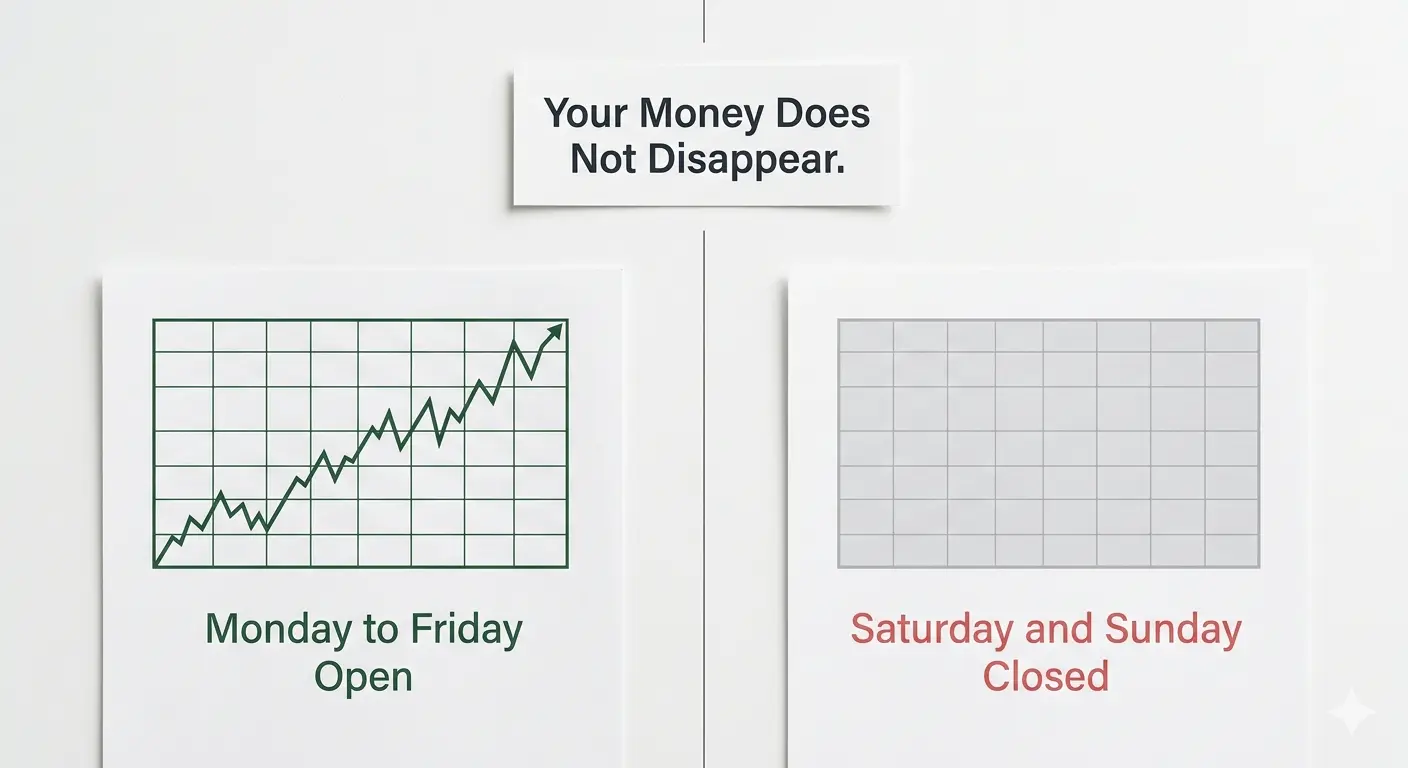
US stock markets are closed on Saturdays and Sundays. There are no regular trading hours on weekends.
But the reason behind this rule is smarter than most people realize. And knowing it makes you a better investor.
The Real Reason the Stock Market Closes on Weekends
This is not about tradition. This is about stability.
One of the main reasons for limited trading hours is liquidity or how much buying and selling is going on at a given time.
When fewer people participate in trading, prices become unstable. A single large order can move a stock dramatically when volume is low. Keeping fixed trading hours ensures enough buyers and sellers are active at the same time to keep prices fair and stable.
Think of it like a busy marketplace. When thousands of people are buying and selling the same item, the price stays fair. When only ten people show up, one big buyer can manipulate the entire price. The weekend closure protects everyday investors from exactly that kind of manipulation.
"Market hours exist not to limit investors but to protect them."
There is also a practical side. Brokers, regulators, clearing houses, and financial institutions all need time to process the enormous volume of transactions that happen every single trading day. Weekends give the entire financial system time to breathe, audit, and reset before the next week begins.
Without that reset, errors would pile up. Settlements would fail. The system would crack.
What the Market Looks Like Around the Weekend
Understanding the full schedule helps you plan smarter moves.
The US stock market opens at 9:30 am Eastern Time and closes at 4:00 pm Eastern Time Monday through Friday.
But the window around that schedule is wider than most people realize.
Pre-market trading hours run from 4:00 am to 9:30 am Eastern Time. After hours trading runs from 4:00 pm to 8:00 pm Eastern Time. Certain brokers have different pre-market and after hours trading times.
Day | Trading Available | Best Time to Act |
|---|---|---|
Friday | Regular plus after hours until 8:00 pm | Place weekend prep orders before close |
Saturday | No stock trading available | Research and planning only |
Sunday | No stock trading available | Pre-market orders can be queued |
Monday | Regular plus pre-market from 4:00 am | Early movers act on weekend news |
The Weekend News Problem Every Investor Faces
Here is something most casual investors never think about. The market closes. But the world keeps moving.
Companies release earnings reports on weekends. Governments announce major policy changes. Wars escalate. Natural disasters happen. All of this news builds up while markets are closed and then explodes into prices the moment Monday morning arrives.
Occasionally stock markets will close early at 1:00 pm on the day before or after major holidays and stock markets have closed unexpectedly for national tragedies natural disasters and days of mourning.
Serious investors use this knowledge as an advantage. They read weekend news carefully. They identify which stocks will be affected. They place pre-market orders ready for Monday morning. By the time most people open their apps at 9:30 am the smart money has already moved.
A real life observation: When a major pharmaceutical company announced successful drug trial results on a Sunday evening, investors who placed pre-market orders at 4:00 am Monday captured gains of over 20 percent before the regular trading session even began. The investors who waited until 9:30 am bought at already inflated prices.
"Weekends are when smart investors do their homework. Monday is when they collect the results."
What You Can Actually Do With Your Money on Weekends
Just because stocks are closed does not mean your financial life stops. Here are real options available to you every weekend.
Option 1 — Trade Cryptocurrency
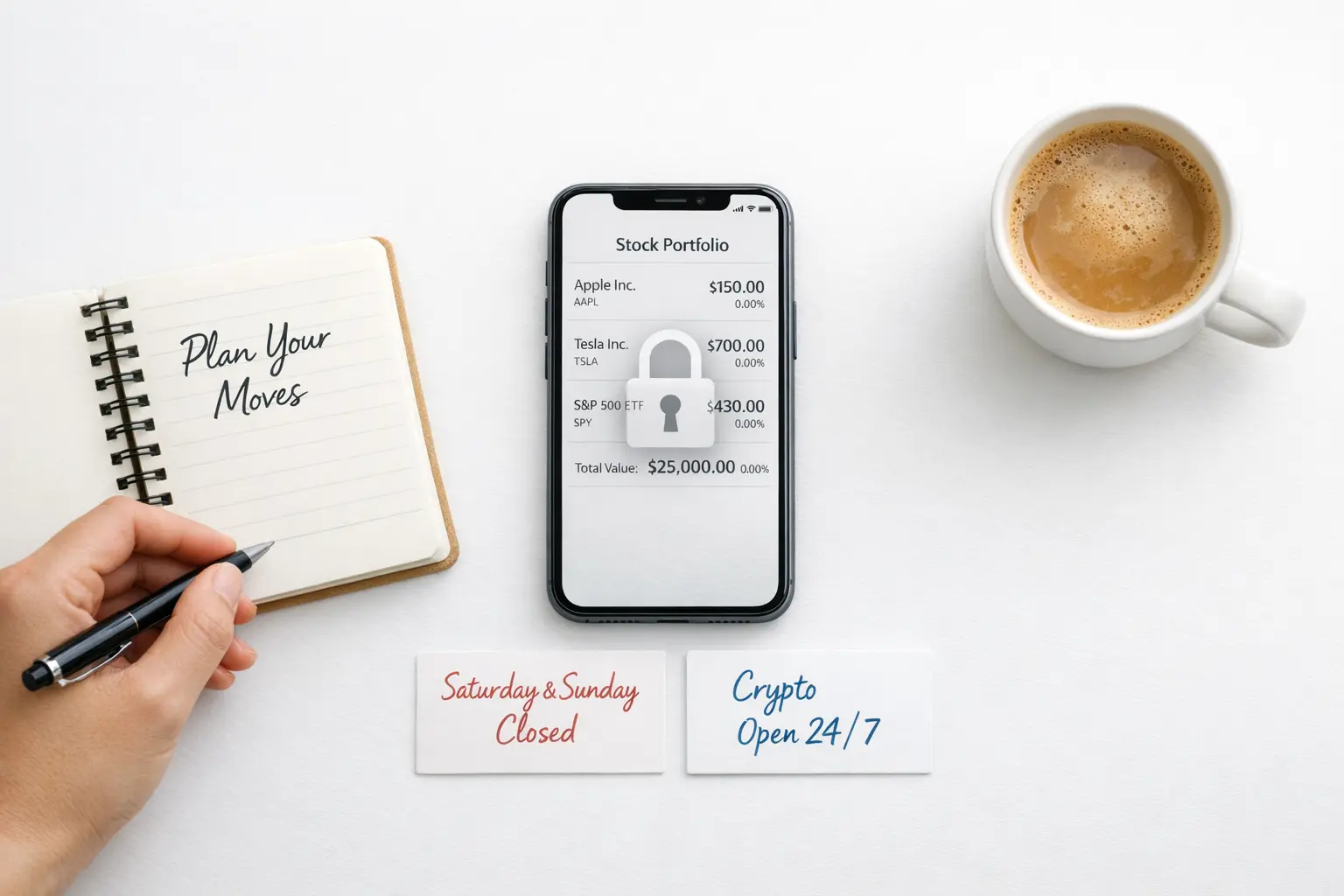
Cryptocurrency markets are always open — 24 hours per day 365 days per year.
Bitcoin, Ethereum, and thousands of other digital assets trade continuously through every weekend and every holiday. If you need to make a financial move on a Saturday, crypto is your only major market option. Just remember the risks are higher and prices move more dramatically.
Option 2 — Queue Your Stock Orders
Most modern brokers allow you to place limit orders over the weekend that automatically execute when the market opens Monday morning. This means you can do your research on Saturday, make your decision on Sunday, and wake up Monday with your trades already done.
Option 3 — Review and Rebalance Your Portfolio
Weekends are the perfect time to look at your overall investment mix without the pressure of live prices moving in real time. Are you too heavy in one sector? Is one stock taking up too much of your portfolio? These are weekend questions that lead to smarter weekday decisions.
Option 4 — Read and Research
Regular stock market trading hours are 9:30 am to 4:00 pm Eastern Time Monday through Friday applying on all non-holiday weekdays.
Every hour the market is closed is an hour you can spend understanding it better. Read company earnings reports. Follow financial news. Study the stocks you want to buy. The investors who read the most consistently make the best decisions.
"The market gives everyone the same hours. What you do with the hours it is closed separates good investors from great ones."
Insight: Is the Weekend Closure About to Change
This is a question gaining traction in financial circles. As technology advances and global markets operate around the clock, pressure is building to extend US trading hours.
Occasionally stock markets have closed unexpectedly for national tragedies natural disasters and days of mourning showing that closures can happen at any time for any reason.
Some brokers are already offering limited weekend trading through alternative systems. But the major exchanges, NYSE and Nasdaq, have no announced plans to open on weekends. The infrastructure, regulatory framework, and institutional habits that support weekend closures are deeply embedded in the American financial system.
Change may come eventually. But for now the weekend closure remains a permanent feature of US investing.
Until that changes the smartest move is to work with the system not against it.
Conclusion: Turn the Closed Market Into Your Advantage
Most investors see the weekend closure as an inconvenience. The smartest investors see it as an opportunity.
Two full days where prices cannot move against you. Two full days to think clearly without the noise of live markets. Two full days to research, plan, and prepare for the week ahead.
US stock markets are closed on Saturdays and Sundays with no regular trading hours on weekends.
That is not a limitation. That is breathing room. Use it wisely and Monday morning becomes your competitive advantage.
"The market rests on weekends so that investors can think. Most people waste that gift. Do not be most people."