You don’t see military satellites.
You don’t hear them.
But they’re always there.
Orbiting silently, tracking movement, scanning terrain, and feeding data back to command systems on Earth. In modern warfare, they are often the first to know—and sometimes the reason conflicts never escalate.
Main Explanation
Military satellites are part of a larger intelligence system. Their job is simple in theory: observe and report.
In practice, it’s far more advanced.
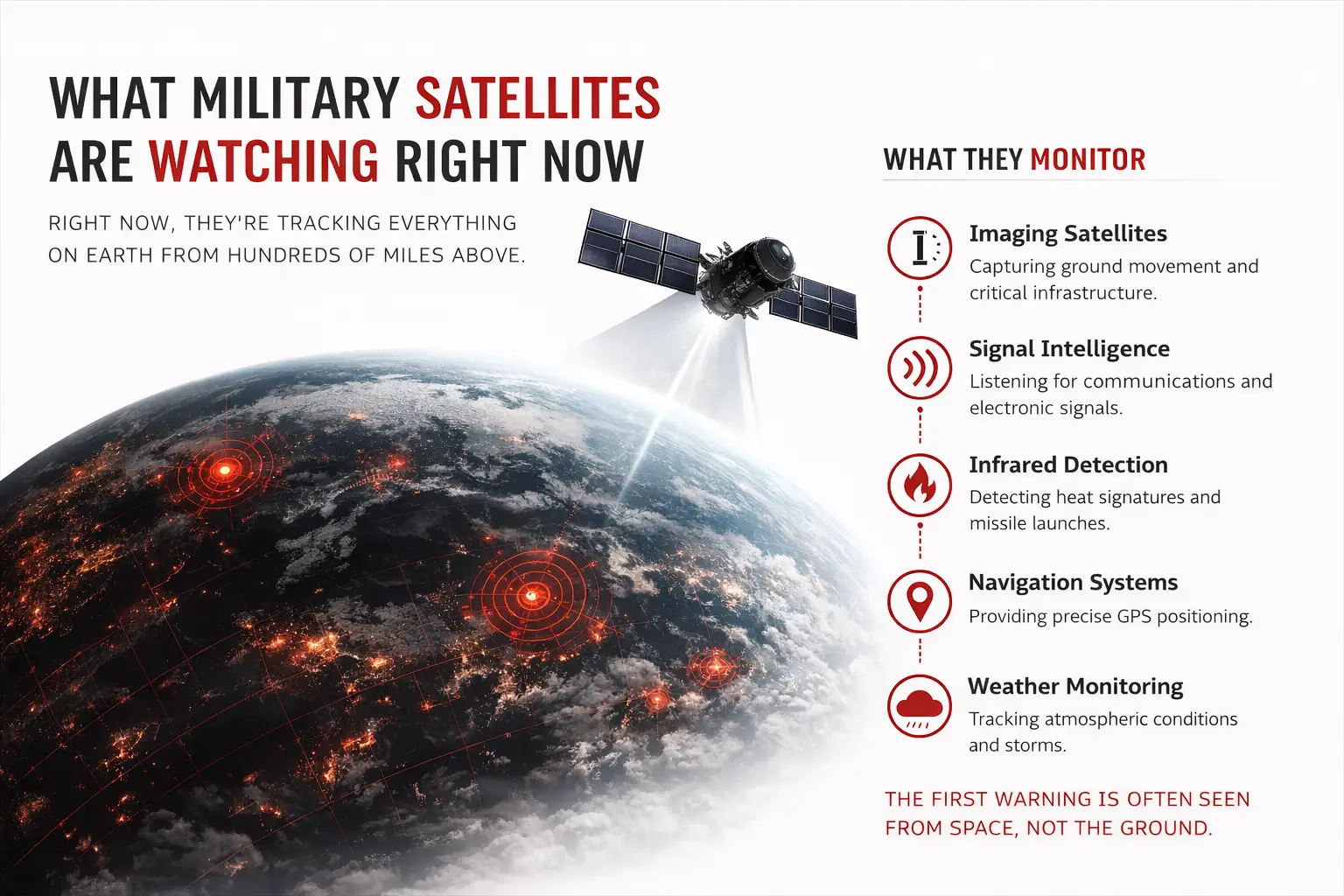
Here’s what they actually monitor:
Satellite Function | What It Tracks | Why It Matters |
|---|---|---|
Imaging Satellites | Ground movement, infrastructure | Visual confirmation of activity |
Signal Intelligence | Communications, electronic signals | Detects intent and coordination |
Infrared Detection | Heat signatures, missile launches | Early warning systems |
Navigation Systems | Positioning (GPS) | Precision for operations |
Weather Monitoring | Atmospheric conditions | Mission planning accuracy |
Imaging satellites capture high-resolution visuals of specific areas. Not just once—but repeatedly, building patterns over time.
Signal intelligence satellites listen.
They detect communication signals, radar activity, and electronic emissions. Even if the content isn’t fully visible, the pattern tells a story.
Infrared systems track heat.
This is how missile launches are detected within seconds. The heat signature gives it away before visual confirmation even happens.
And then there’s positioning.
GPS, powered by satellites, allows precise navigation for aircraft, drones, and even ground units.
Everything connects.
Impact
Military satellites change the timeline of decision-making.
Instead of reacting after something happens, systems can respond before it fully develops.
That’s a major shift.
It reduces uncertainty. It increases awareness. And in some cases, it prevents escalation entirely.
“The first signal is often seen from space, not the ground.”
“Information arrives before action.”
“Whoever sees first, decides first.”
Real-Life Observation
Open any maps app on your phone.
You’re using satellite data.
Now scale that up.
Imagine real-time, classified-level imagery, updated constantly, analyzed by systems designed to detect even small changes.
That’s the level military satellites operate on.
Trend: Then vs Now
Satellite capabilities have evolved rapidly.
Earlier Systems | Modern Systems |
|---|---|
Delayed image capture | Near real-time monitoring |
Lower resolution | High-definition imaging |
Limited coverage | Global continuous coverage |
Manual analysis | AI-assisted detection |
Earlier satellites provided snapshots.
Now they provide streams of data.
And that changes everything.
Insight
Here’s what most people underestimate.
Satellites don’t just collect data.
They create context.
By tracking patterns over time—movement, signals, behavior—they help analysts understand not just what is happening, but what might happen next.
That predictive layer is where real power lies.
Conclusion
So what are military satellites watching right now?
More than you’d expect.
Movement, signals, heat, timing—layered together into a constant flow of intelligence.
They don’t act.
But they shape every action that follows.
And in modern strategy, the side that sees clearly from above often controls what happens below.