Let’s imagine a different scenario.
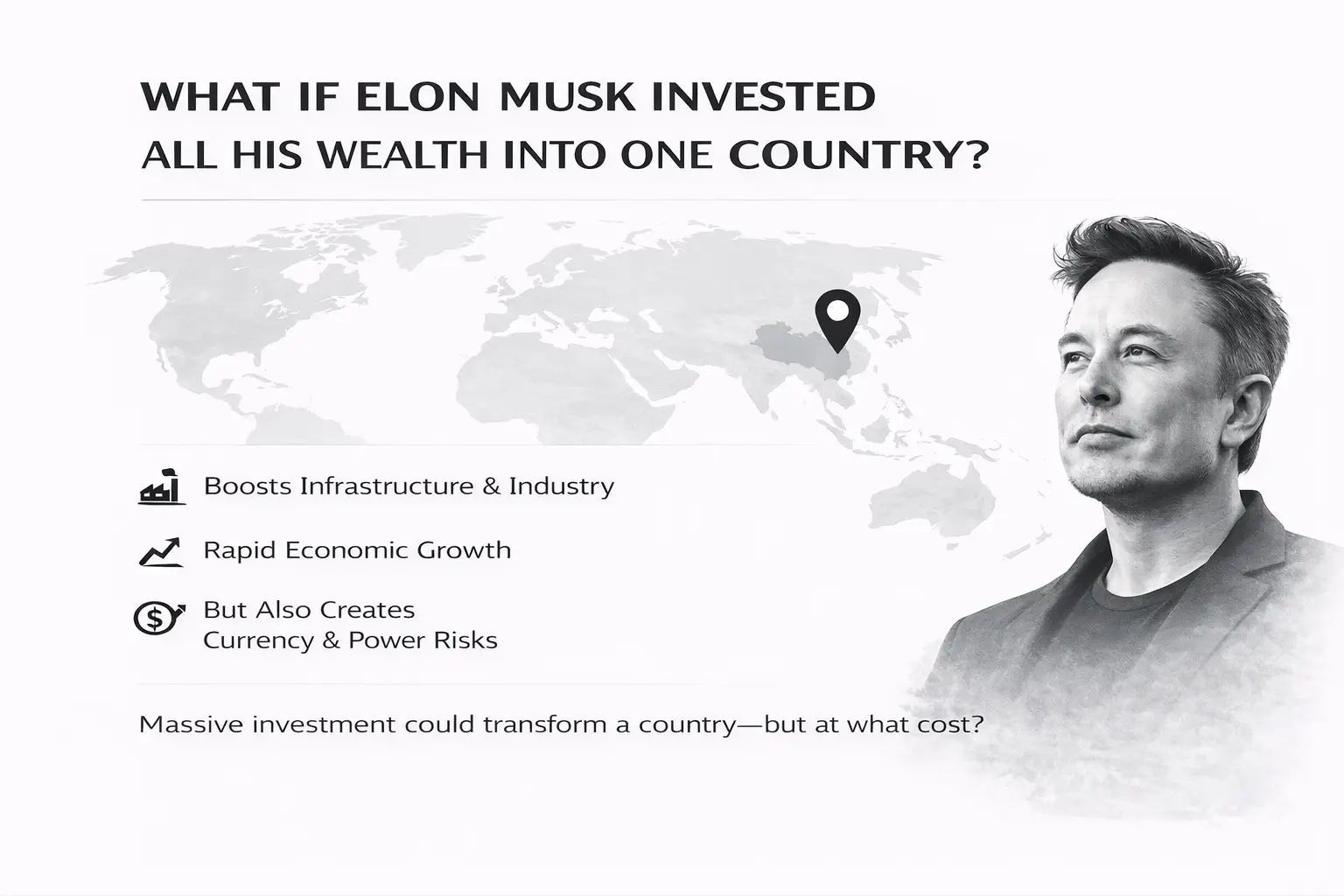
Instead of distributing wealth, Elon Musk invests all $800 billion into one country.
Infrastructure, technology, industry—everything funded at once.
It sounds like instant transformation.
But large-scale capital doesn’t just build economies.
It reshapes them.
Main Explanation
An $800 billion investment is massive—larger than the GDP of many countries.
Here’s how it could impact:
Investment Area | Immediate Effect | Long-Term Outcome |
|---|---|---|
Infrastructure | Roads, energy, transport growth | Higher productivity |
Technology | Innovation boost | Skilled workforce |
Industry | Job creation | Economic expansion |
Capital Flow | Surge in money supply | Inflation pressure |
Influence | Strategic control | Dependency risks |
At first, everything improves.
Jobs increase. Businesses grow. Development speeds up.
But then complexity begins.
Impact
Too much money, too quickly, can destabilize an economy.
Prices rise. Inflation increases. Cost of living goes up.
Local businesses may struggle to compete with large-scale, heavily funded projects.
And then comes influence.
When one source provides that much capital, it gains leverage.
Economic decisions may start aligning with that influence.
“Money builds fast—but balance keeps it stable.”
“Rapid growth can hide long-term risks.”
“Capital doesn’t just grow economies. It shapes control.”
Real-Life Observation
Look at regions that receive heavy foreign investment.
At first, growth is visible—jobs, infrastructure, business activity.
But over time, housing prices rise. Costs increase. Local systems adjust.
Now scale that effect to $800 billion.
Trend: Then vs Now
Investment dynamics have changed.
Earlier Model | Modern Reality |
|---|---|
Government-led growth | Private capital influence |
Slow development | Rapid capital injection |
Local control | Global stakeholder impact |
Today, individuals and companies can influence economies at scale.
That shift is significant.
Insight
Here’s the key idea.
Investment at this level doesn’t just create growth.
It creates dependency and influence.
A country benefits—but also becomes tied to the source of capital.
And that relationship shapes future decisions.
Conclusion
So what happens if Elon Musk invests $800 billion into one country?
Fast growth. Visible transformation. New opportunities.
But also inflation, imbalance, and long-term dependency.
Because at that scale, money is not just economic.
It’s structural power.
And once that shift happens, it’s hard to undo.
Let’s imagine a different scenario.
Instead of distributing wealth, Elon Musk invests all $800 billion into one country.
Infrastructure, technology, industry—everything funded at once.
It sounds like instant transformation.
But large-scale capital doesn’t just build economies.
It reshapes them.
Main Explanation
An $800 billion investment is massive—larger than the GDP of many countries.
Here’s how it could impact:
Investment Area | Immediate Effect | Long-Term Outcome |
|---|---|---|
Infrastructure | Roads, energy, transport growth | Higher productivity |
Technology | Innovation boost | Skilled workforce |
Industry | Job creation | Economic expansion |
Capital Flow | Surge in money supply | Inflation pressure |
Influence | Strategic control | Dependency risks |
At first, everything improves.
Jobs increase. Businesses grow. Development speeds up.
But then complexity begins.
Impact
Too much money, too quickly, can destabilize an economy.
Prices rise. Inflation increases. Cost of living goes up.
Local businesses may struggle to compete with large-scale, heavily funded projects.
And then comes influence.
When one source provides that much capital, it gains leverage.
Economic decisions may start aligning with that influence.
“Money builds fast—but balance keeps it stable.”
“Rapid growth can hide long-term risks.”
“Capital doesn’t just grow economies. It shapes control.”
Real-Life Observation
Look at regions that receive heavy foreign investment.
At first, growth is visible—jobs, infrastructure, business activity.
But over time, housing prices rise. Costs increase. Local systems adjust.
Now scale that effect to $800 billion.
Trend: Then vs Now
Investment dynamics have changed.
Earlier Model | Modern Reality |
|---|---|
Government-led growth | Private capital influence |
Slow development | Rapid capital injection |
Local control | Global stakeholder impact |
Today, individuals and companies can influence economies at scale.
That shift is significant.
Insight
Here’s the key idea.
Investment at this level doesn’t just create growth.
It creates dependency and influence.
A country benefits—but also becomes tied to the source of capital.
And that relationship shapes future decisions.
Conclusion
So what happens if Elon Musk invests $800 billion into one country?
Fast growth. Visible transformation. New opportunities.
But also inflation, imbalance, and long-term dependency.
Because at that scale, money is not just economic.
It’s structural power.
And once that shift happens, it’s hard to undo.