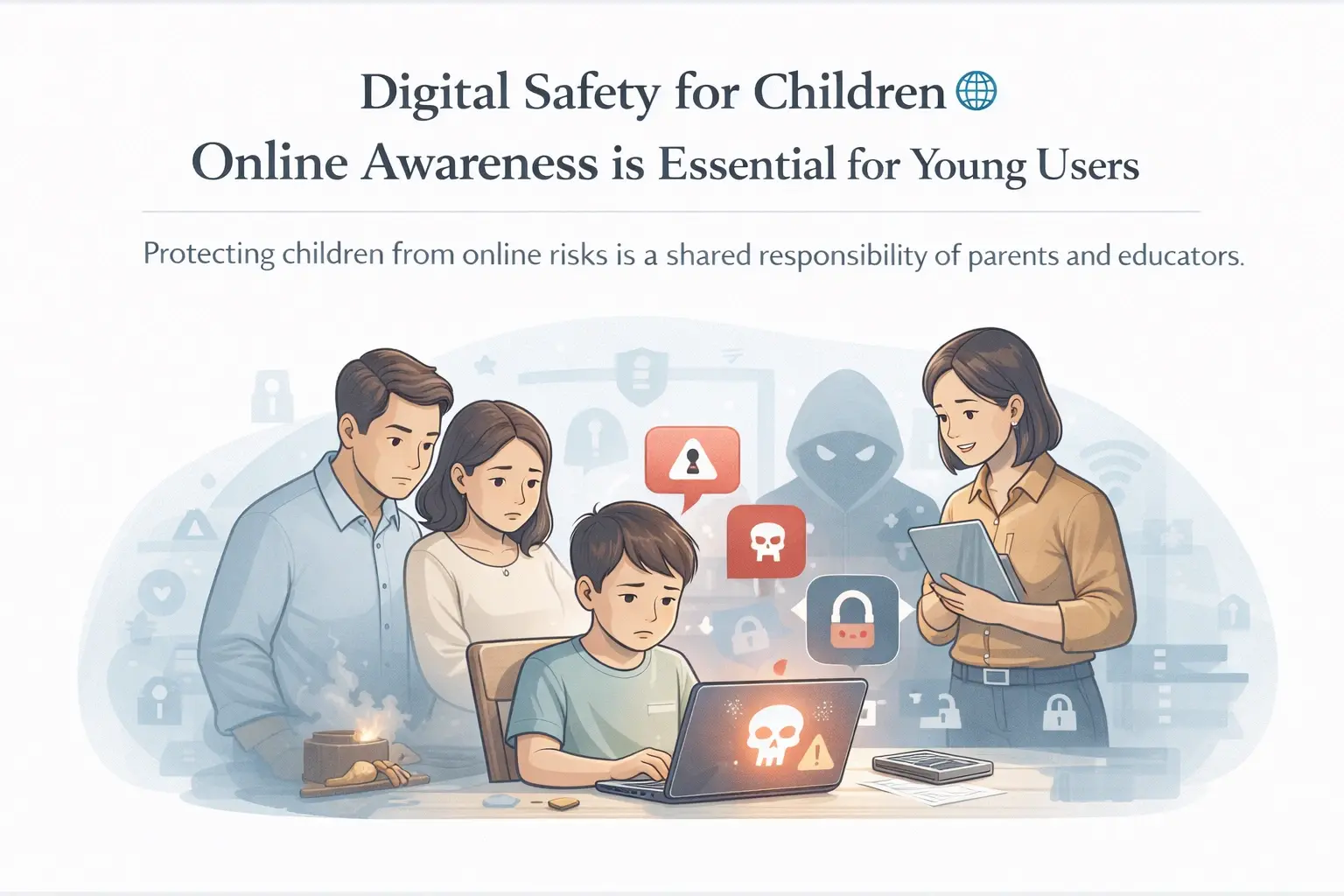
Introduction: A Digital Childhood Without Protection
In today’s world, a child learns to swipe before they learn to write. Smartphones, tablets, and social media are now part of daily life.
But here is the problem.
Access has grown faster than awareness.
From online classes to gaming and social media, children are spending hours on screens. Parents feel proud when kids handle technology easily. But very few stop and ask what risks come with it.
This is where digital safety for children becomes critical.
Main Explanation: What Is Happening and Why
The internet is not just a learning tool. It is also a space full of risks.
Children today face:
Cyberbullying
Online scams
Exposure to harmful content
Privacy threats
And the biggest issue is this.
They often do not even realize it.
Why is this happening?
First, digital access is increasing rapidly. Even small-town families now have smartphones and internet access.
Second, there is a gap in online safety awareness. Schools focus on studies, not digital behavior. Parents are busy or not fully aware of online risks.
Third, social media pressure is real. Children want likes, followers, and attention. They share more than they should.
You might have seen this.
A child posting personal photos or information without thinking twice.
It feels normal. But it is not safe.
“The internet does not forget. What a child shares today can follow them for years.”
Impact: Real Effects on Children
The impact of unsafe internet use is serious.
And often invisible.
Children face mental stress due to cyberbullying. A simple comment or message can affect their confidence deeply.
In many cases, kids stop sharing problems with parents. They feel judged or misunderstood.
There is also fear.
Fear of being exposed, embarrassed, or targeted online.
“A screen can hide tears, but it cannot remove pain.”
Financial risks are growing too. Online games and scams sometimes trick children into making payments or sharing sensitive data.
In India, cases of online fraud involving teenagers have increased in recent years. This shows a clear trend.
More access. More risk.
And less protection.
Insight: The Truth We Often Ignore
Let’s be honest.
Most parents think, “My child is smart. They know what they are doing.”
But knowing how to use the internet is not the same as knowing how to stay safe.
That is the uncomfortable truth.
“Children are digital users. They are not digital experts.”
And here is another reality.
We give children devices to keep them busy, not to keep them safe.
Think about it.
How often do we check what children watch, who they talk to, or what they share?
Not enough.
This is not about controlling children. It is about guiding them.
A simple conversation can prevent a serious problem.
Yes, it really can.
Conclusion: Safety Is a Shared Responsibility
Online safety for kids is not just a personal issue. It is a shared responsibility.
Parents, teachers, and schools must work together.
Teach children about privacy
Encourage open communication
Set simple digital rules
Build trust, not fear
Because in the end,
“A protected child today becomes a confident adult tomorrow.”
And one more thing to remember:
The internet is powerful. But without awareness, it can be dangerous.
So the real question is not whether children should use the internet.
The real question is are we preparing them to use it safely?