India isn’t just eating mangoes. It’s dominating them.
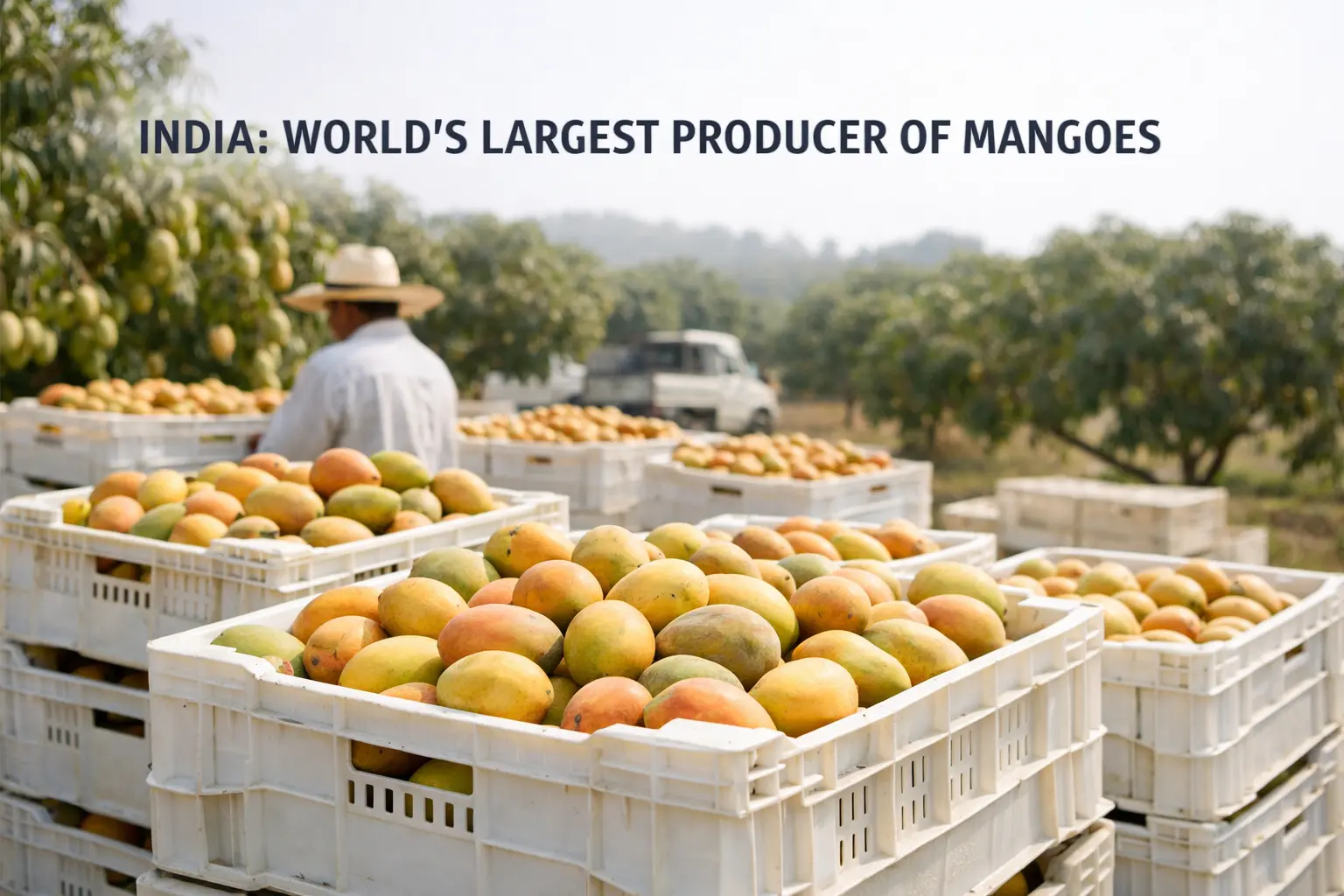
More than half of the world’s mango supply now comes from one country—and that country is India. Over 55% of global production, to be precise. That’s not a lead. That’s a takeover.
This isn’t sudden. It’s just finally visible.
For decades, India has quietly built an unmatched ecosystem around mango cultivation—ideal climate, diverse varieties, and a farming culture deeply rooted in seasonal cycles. But what’s changed now is scale, visibility, and global relevance. The numbers are no longer just impressive—they’re impossible to ignore.
Walk through any wholesale fruit market during peak season, and you’ll see it firsthand. Crates stacked high, the smell of ripeness in the air, traders moving fast, bargaining harder. From Alphonso to Kesar to Dasheri, the diversity alone gives India a structural advantage. Other countries produce mangoes. India produces an ecosystem.
And that ecosystem is expanding.
The rise isn’t just about favorable weather. It’s about consistent output, regional specialization, and a growing push toward export-quality produce. States like Uttar Pradesh, Maharashtra, and Andhra Pradesh are not just farming—they’re scaling. Irrigation improvements, better storage, and supply chain upgrades are slowly tightening what used to be a fragmented system.
Still, let’s not pretend it’s perfect.
A farmer in a small village may grow premium-quality fruit but struggle to access export markets. Meanwhile, middlemen often capture a large chunk of the profit. The gap between production power and earning power remains real.
“Growth doesn’t mean equal gain. It just means bigger numbers.”
Globally, countries like Mexico, Thailand, and Indonesia are strong competitors. They’ve built efficient export pipelines and strong branding in international markets. But here’s the contradiction—India produces the most, yet doesn’t dominate exports at the same level.
That’s the gap.
And it matters.
Because global demand for mangoes is rising fast. Health-conscious consumers are shifting toward natural sugars, tropical fruits are trending in international cuisine, and food chains are experimenting more than ever. Mango-based products—from smoothies to desserts—are no longer seasonal luxuries. They’re becoming staples.
This is where India’s position becomes both powerful and fragile.
On one side, there’s massive opportunity. On the other, there’s pressure to adapt.
A trader exporting mangoes from Mumbai recently put it bluntly: getting the fruit ready is easy—getting it accepted internationally is the real fight. Strict quality checks, packaging standards, and shelf-life requirements often create bottlenecks. A single rejection can wipe out profit margins.
“Being the biggest doesn’t mean being the best in every market.”
That’s the uncomfortable truth.
Back home, the story feels different. For millions of Indians, mango season is personal. It’s not just agriculture—it’s memory. Families buying boxes together, children waiting for the first slice, that unspoken rule of saving the best ones for guests. It’s cultural currency.
You don’t measure that in export data.
But even this emotional connection is evolving. Urban consumers are becoming more selective. Organic labels, chemical-free farming, and premium packaging are influencing buying decisions. A decade ago, people bought mangoes by trust. Today, they buy them by standards.
That shift is subtle, but powerful.
From a trend perspective, India’s mango dominance reflects something bigger—a shift from traditional agriculture to semi-commercial, brand-driven farming. It’s no longer just about growing crops. It’s about positioning them.
And that’s where the next battle lies.
Can India convert its production dominance into global brand dominance?
Right now, the answer is… not fully.
Export volumes are growing, but challenges remain—logistics, compliance, wastage, and inconsistent quality control. While the top tier of producers is adapting fast, a large portion of the system still operates in older, less efficient ways.
That creates friction.
But friction also creates opportunity.
Startups are entering the space. Cold chain logistics are improving. Direct-to-consumer fruit brands are emerging. Slowly, the system is tightening. Not perfectly—but noticeably.
“Markets don’t reward potential. They reward execution.”
And execution is where the next phase of this story will be decided.
There’s also a deeper layer here—climate uncertainty. Mango crops are sensitive. Unseasonal rains, heatwaves, and shifting weather patterns can disrupt yield and quality. A bad season doesn’t just affect farmers—it ripples across supply chains, prices, and exports.
So while India leads today, the future isn’t guaranteed.
It has to be defended.
Because global agriculture is no longer local. It’s competitive, data-driven, and brutally efficient. Countries that adapt faster win faster.
India has the scale. It has the heritage. It even has the demand.
What it needs now is precision.
Because producing 55% of the world’s mangoes is impressive.
But owning the future of mango trade? That’s a different game entirely.
And that game has just begun.