A jet flying at high speed should be easy to detect.
Metal body. Heat signature. Movement.
So how do stealth jets avoid radar?
They don’t just rely on speed or altitude.
They rely on invisibility—not literal, but functional.
Main Explanation
Stealth technology is built around one goal: reduce detection.
Radar works by sending signals that bounce back from objects. If the signal returns, the object is detected.
Stealth jets are designed to break that cycle.
Here’s how:
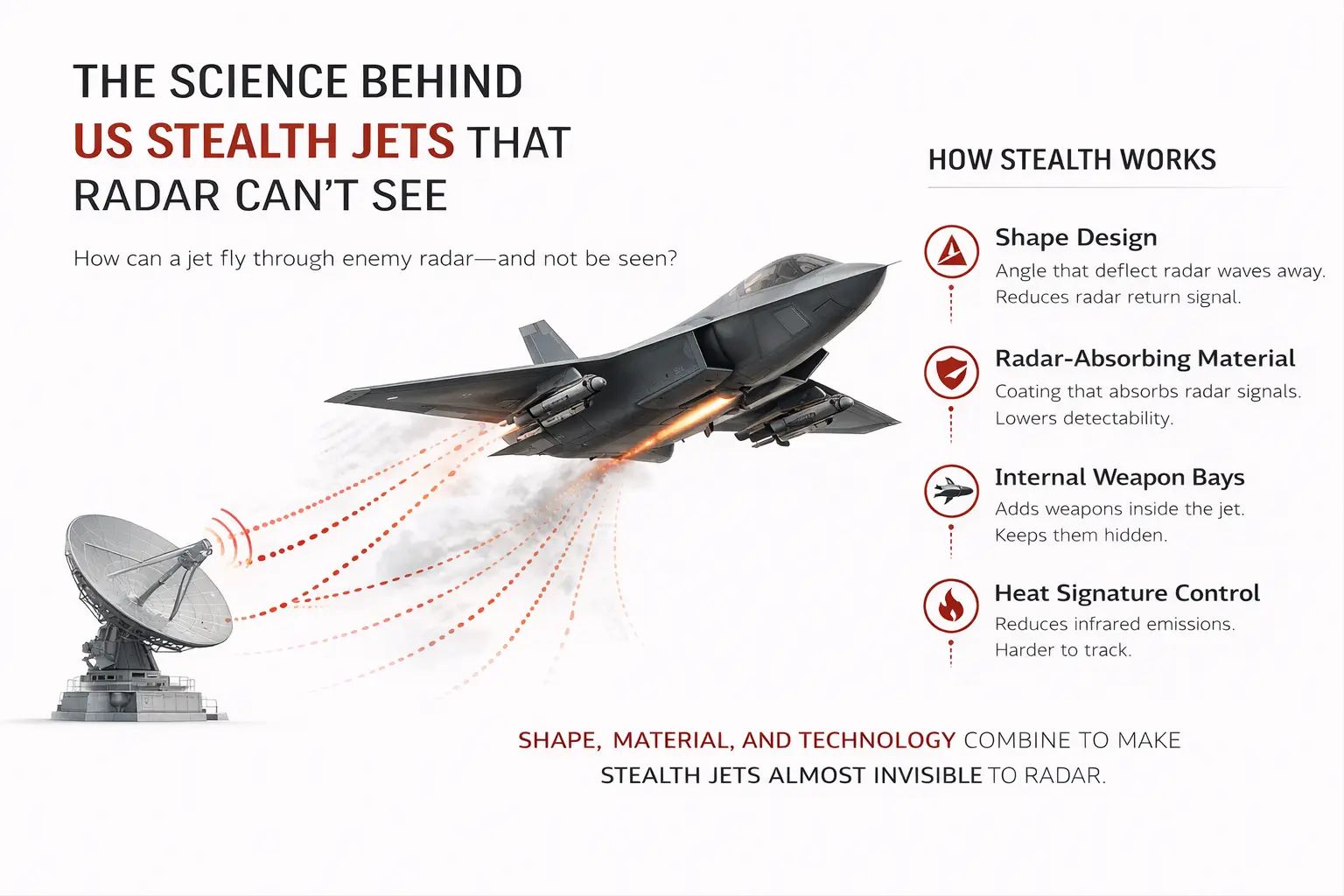
Stealth Feature | What It Does | Why It Matters |
|---|---|---|
Shape Design | Deflects radar waves away | Reduces radar return signal |
Radar-Absorbing Material | Absorbs signals instead of reflecting | Makes aircraft harder to detect |
Internal Weapon Bays | Keeps weapons hidden inside | Avoids radar reflections |
Heat Signature Control | Reduces infrared visibility | Avoids thermal tracking |
Smooth Surface Design | Minimizes sharp edges | Limits radar scattering |
The shape is critical.
Stealth jets are built with angled surfaces. When radar waves hit them, they don’t bounce back to the source. They scatter away.
That alone reduces visibility.
Then comes material.
Special coatings absorb radar waves instead of reflecting them. It’s not perfect invisibility—but it lowers detection significantly.
Weapons are stored inside the aircraft.
Because anything attached outside increases radar reflection.
Even heat is managed.
Engines are designed to reduce infrared signals, making it harder for heat-seeking systems to track them.
Impact
Stealth technology changes engagement completely.
Instead of being seen and then reacting, stealth jets can operate before being detected.
That gives a timing advantage.
And timing often decides outcomes.
“Stealth isn’t about being invisible. It’s about being late to detection.”
“If you’re not seen, you control the moment.”
“Detection delayed is advantage gained.”
Real-Life Observation
Think about how visibility works in everyday life.
If something reflects light directly at you, you see it clearly.
If it doesn’t reflect back, it becomes harder to notice.
Stealth works on a similar principle.
Just with radar instead of light.
Trend: Then vs Now
Stealth technology has evolved over time.
Earlier Aircraft | Modern Stealth Jets |
|---|---|
High radar visibility | Low observable design |
External weapons | Internal weapon storage |
Heat-heavy engines | Reduced infrared signatures |
Reactive missions | Pre-emptive operations |
Earlier aircraft focused on speed and firepower.
Now, avoiding detection is just as important.
Insight
Here’s the key idea.
Stealth doesn’t make a jet invisible.
It makes detection unreliable.
That uncertainty forces opponents to react differently. Systems become less confident. Responses slow down.
And that hesitation creates opportunity.
Conclusion
So what’s the science behind US stealth jets that radar can’t see?
It’s a combination of shape, material, and control.
Every detail is engineered to reduce visibility—not eliminate it, but delay it.
And in modern warfare, even a few minutes of delayed detection can change everything.