Some cases don't just capture public attention. They haunt it.
Betty Broderick spent over three decades behind bars. She was denied parole. She never stopped proclaiming herself the real victim. And somehow, with every passing year, America kept circling back to her story — angrier, more divided, more fascinated than before.
Yesterday, that story ended. Betty Broderick died on May 8, 2026, after being hospitalized for several days prior. The woman who became a household name by committing a cold-blooded double murder — and somehow made half the country feel sympathy for her — is gone. But the conversation she ignited? That's far from over. Wikipedia
What Happened — and Why It Still Matters
The facts of the case are not in dispute. On the morning of November 5, 1989, the bodies of newlyweds Dan and Linda Broderick were found inside their upscale San Diego home. The shooter was Betty Broderick, Dan's ex-wife, who had fired five rounds before fleeing the scene. AETV
What made the story explode was everything that came before the gun.
Betty had worked multiple jobs to support Dan through medical school and then Harvard Law School. By the mid-1970s, they had moved west, settled into the affluent La Jolla neighborhood, and become regulars on the city's elite social scene. She had given him years, four children, and her entire identity as a wife and mother. AETV
Then Dan hired Linda Kolkena — younger, attractive, his legal assistant. Betty suspected an affair by 1983. Dan eventually admitted to it and moved out of the family home in 1985. The divorce that followed was, by all accounts, vicious. AETV
Betty felt she had been discarded after building the very life that made Dan Broderick successful. Dan used the legal system with ruthless precision. Betty claimed he used his legal influence to win sole custody of their children, sell their house against her wishes, and cheat her out of her rightful share of his income. AETV
She unraveled publicly and loudly — leaving profane voicemails, driving her car through his door, vandalizing his home. And then, one November morning, she walked into their bedroom with a gun.
At a second trial in 1991, she was convicted of two counts of second-degree murder and sentenced to 32 years to life in prison. Wikipedia
The Impact — A Nation That Couldn't Pick a Side
Here's the uncomfortable truth that true crime fans rarely say out loud: Betty Broderick became famous not just because of what she did, but because of why so many people understood it.
Some saw Betty as a cold-hearted killer. Others viewed her as a symbol of a woman pushed past her limits by a system that failed her. AETV
That split never healed. If anything, it deepened with time.
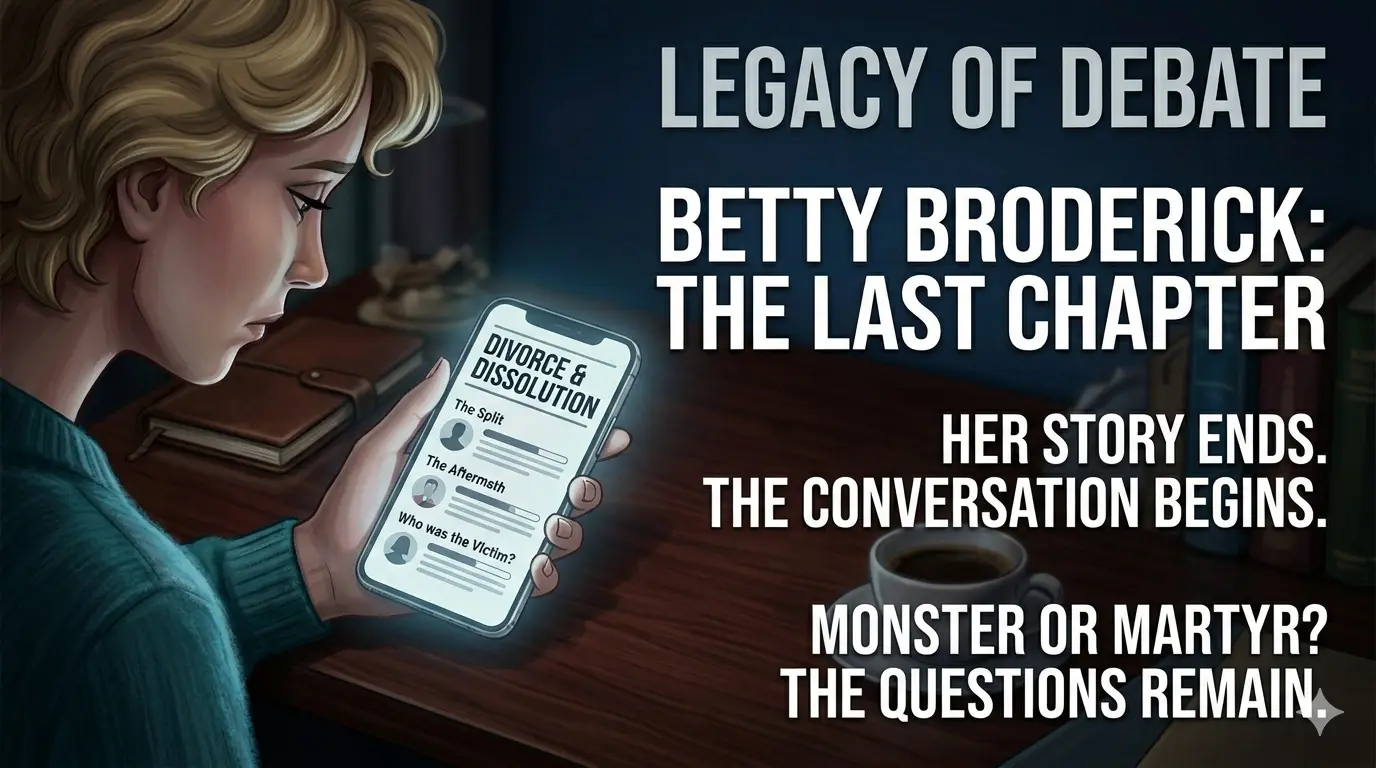
A made-for-TV movie aired in two parts in 1992. In 2020, an eight-episode miniseries dramatized the case on Netflix, starring Amanda Peet and Christian Slater. Each new adaptation brought a fresh wave of debate. Reddit threads. TikTok breakdowns. Podcast episodes with millions of downloads. Every generation that discovered the story had the same argument: monster or martyr? Wikipedia
Betty appeared before the parole board on two separate occasions and was denied both times. Her next scheduled parole hearing had been set for January 2032, when she would have been 84. She never made it. OxygenGeorge Pallas
Insight — The Question Nobody Wants to Answer
People don't debate Betty Broderick because they approve of murder. They debate her because her story forces a question the legal system never fully answered: what happens when the system itself becomes a weapon?
Dan Broderick was not just a husband who left. He was a powerful attorney who knew exactly how to use the courts. Betty, whatever her flaws, was outgunned in every courtroom that mattered — custody, divorce settlements, restraining orders — until the only power she had left fit in a holster.
That doesn't justify two murders. Nothing does.
But it explains why, even now, millions of people feel something complicated when they hear her name. Rage. Pity. Recognition. Fear. The fear that the life you built with someone could be surgically dismantled while the law watches and shrugs.
Women who stayed home, sacrificed careers, and trusted their partners to honor that sacrifice saw themselves in Betty Broderick. That reflection terrified them — and they couldn't look away.
Conclusion
Betty Broderick died in prison, never free, never fully condemned in the court of public opinion. She was a killer. She was also a woman who felt the ground disappear beneath her feet and chose catastrophically wrong in response.
America loved debating her because her story was never really about one woman in one bedroom in San Diego.
It was about power. About what happens when love becomes leverage. About the quiet violence that leaves no marks — right up until the moment it does.
She's gone now. But the questions she left behind? Those have no parole date.