A few years ago, drones were seen as support tools.
Now?
They’re central.
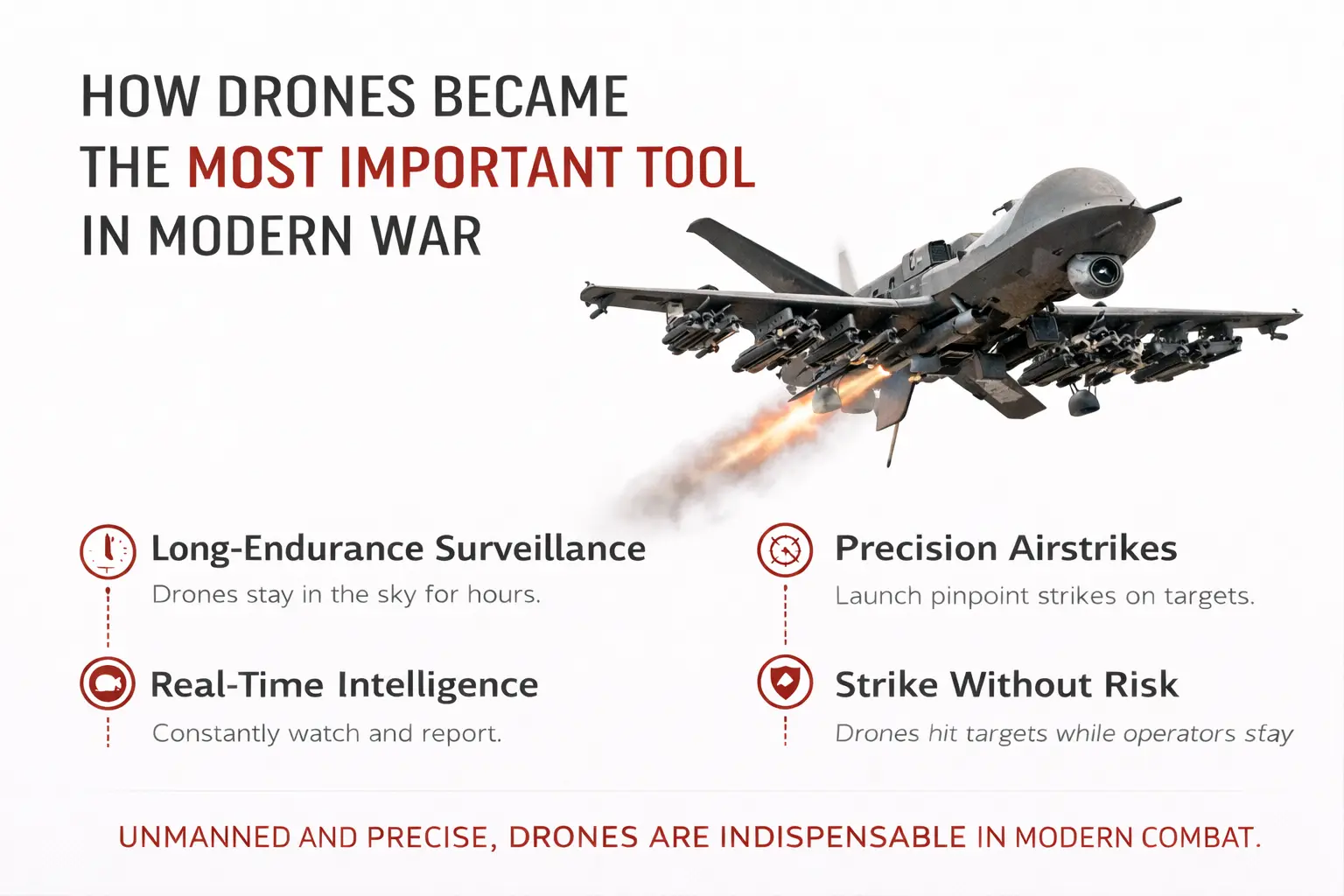
From surveillance to precision strikes, military drones have reshaped how operations are planned and executed. Not loudly. Not suddenly. But steadily.
And that shift changed everything.
Main Explanation
Military drones—also known as UAVs (Unmanned Aerial Vehicles)—operate without a pilot onboard. They are controlled remotely or follow pre-programmed paths.
But the real advantage isn’t just that they’re unmanned.
It’s what that allows them to do.
Here’s a clear breakdown:
Capability | What Drones Do | Why It Matters |
|---|---|---|
Long-Endurance Flight | Stay airborne for 20+ hours | Continuous surveillance |
Remote Operation | Controlled from safe distance | Zero pilot risk |
Precision Targeting | Track and strike specific targets | Reduced collateral damage |
Real-Time Data | Send live video and intelligence | Faster decision-making |
Cost Efficiency | Cheaper than fighter jets | Scalable operations |
Drones can stay in the air far longer than traditional aircraft. That alone makes them valuable.
But combine that with real-time video feed, and you get something more powerful—continuous awareness.
Operators can monitor an area for hours, track movement, and act when needed.
Without being physically present.
Impact
Drones changed the pace of warfare.
Decisions are faster. Responses are more precise. Risks to personnel are lower.
And perhaps most importantly—they reduce the need for large-scale deployments.
You don’t always need boots on the ground when eyes are already in the sky.
“Drones don’t replace soldiers. They reduce when soldiers are needed.”
“The longer you can watch, the better you can act.”
“Modern warfare favors information over presence.”
Real-Life Observation
Even outside military use, drones are everywhere now—delivery, photography, agriculture.
That tells you something.
The technology scaled fast.
Now imagine that same concept, but more advanced, more precise, and used in high-stakes environments.
That’s what military drones represent.
Trend: Then vs Now
The evolution of drones has been rapid.
Earlier Use | Modern Use |
|---|---|
Basic surveillance | Full mission execution |
Short flight duration | Long-endurance operations |
Limited control | Advanced remote + AI assistance |
Support role | Primary operational tool |
Earlier, drones were just observers.
Now, they’re decision enablers.
And sometimes, decision executors.
Insight
Here’s the key shift.
Drones separate presence from risk.
You can monitor, analyze, and act—without putting a pilot in danger.
That changes strategy at a fundamental level.
It allows more flexibility, more patience, and more control over timing.
Conclusion
So how did drones become the most important tool in modern war?
They didn’t force their way in.
They proved their value—mission after mission.
Longer flight time, lower risk, real-time intelligence, and precision capability made them hard to ignore.
And now?
They’re not just part of the system.
They’re shaping it.
A few years ago, drones were seen as support tools.
Now?
They’re central.
From surveillance to precision strikes, military drones have reshaped how operations are planned and executed. Not loudly. Not suddenly. But steadily.
And that shift changed everything.
Main Explanation
Military drones—also known as UAVs (Unmanned Aerial Vehicles)—operate without a pilot onboard. They are controlled remotely or follow pre-programmed paths.
But the real advantage isn’t just that they’re unmanned.
It’s what that allows them to do.
Here’s a clear breakdown:
Capability | What Drones Do | Why It Matters |
|---|---|---|
Long-Endurance Flight | Stay airborne for 20+ hours | Continuous surveillance |
Remote Operation | Controlled from safe distance | Zero pilot risk |
Precision Targeting | Track and strike specific targets | Reduced collateral damage |
Real-Time Data | Send live video and intelligence | Faster decision-making |
Cost Efficiency | Cheaper than fighter jets | Scalable operations |
Drones can stay in the air far longer than traditional aircraft. That alone makes them valuable.
But combine that with real-time video feed, and you get something more powerful—continuous awareness.
Operators can monitor an area for hours, track movement, and act when needed.
Without being physically present.
Impact
Drones changed the pace of warfare.
Decisions are faster. Responses are more precise. Risks to personnel are lower.
And perhaps most importantly—they reduce the need for large-scale deployments.
You don’t always need boots on the ground when eyes are already in the sky.
“Drones don’t replace soldiers. They reduce when soldiers are needed.”
“The longer you can watch, the better you can act.”
“Modern warfare favors information over presence.”
Real-Life Observation
Even outside military use, drones are everywhere now—delivery, photography, agriculture.
That tells you something.
The technology scaled fast.
Now imagine that same concept, but more advanced, more precise, and used in high-stakes environments.
That’s what military drones represent.
Trend: Then vs Now
The evolution of drones has been rapid.
Earlier Use | Modern Use |
|---|---|
Basic surveillance | Full mission execution |
Short flight duration | Long-endurance operations |
Limited control | Advanced remote + AI assistance |
Support role | Primary operational tool |
Earlier, drones were just observers.
Now, they’re decision enablers.
And sometimes, decision executors.
Insight
Here’s the key shift.
Drones separate presence from risk.
You can monitor, analyze, and act—without putting a pilot in danger.
That changes strategy at a fundamental level.
It allows more flexibility, more patience, and more control over timing.
Conclusion
So how did drones become the most important tool in modern war?
They didn’t force their way in.
They proved their value—mission after mission.
Longer flight time, lower risk, real-time intelligence, and precision capability made them hard to ignore.
And now?
They’re not just part of the system.
They’re shaping it.